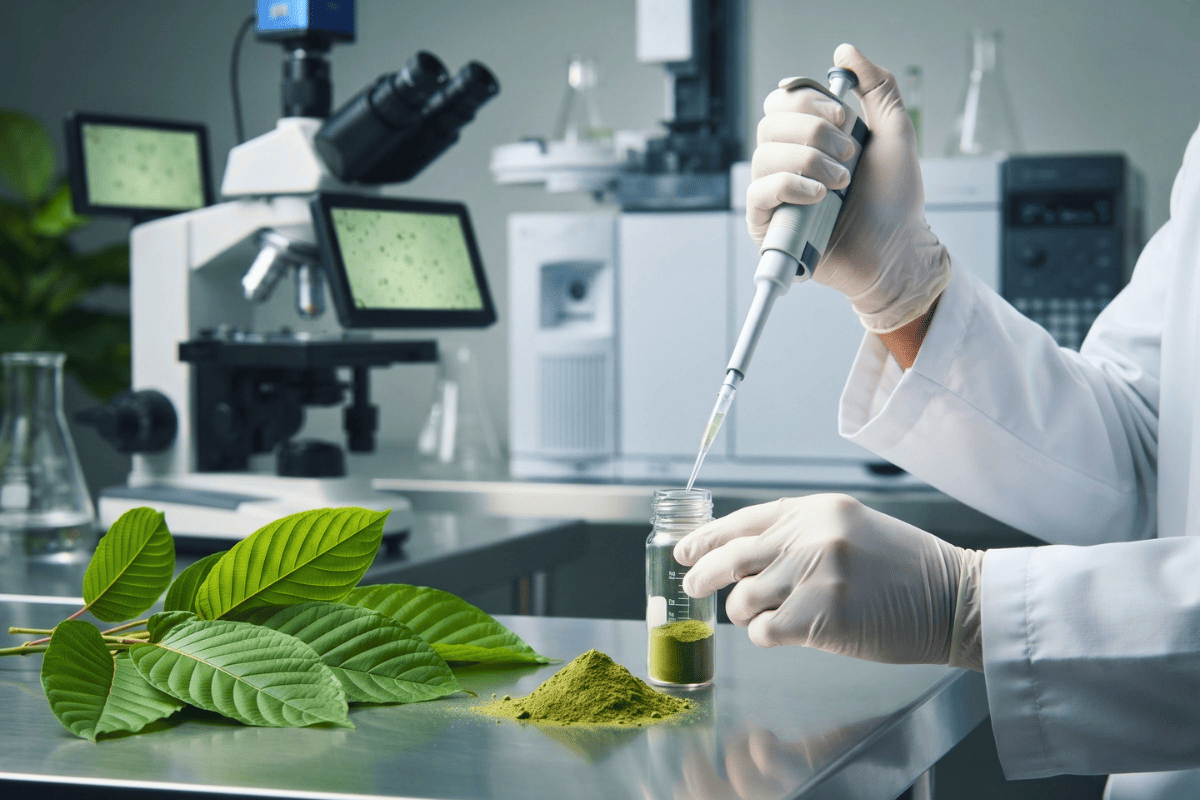

Kratom lab testing matters because it gives buyers more information about a product’s identity, alkaloid content, and potential contaminants. A lot-specific Certificate of Analysis (COA) from an independent laboratory can also help you verify that the test results correspond to the product you’re considering.
Key Takeaways:
- Lab testing provides product information — It can identify the plant material and report alkaloid levels and contaminant testing.
- Third-party testing adds transparency — An independent laboratory provides testing results separate from the vendor’s own claims.
- A COA connects the results to a batch — The lot or batch number helps you determine whether the report actually applies to the product you’re buying.
- Testing and GMP certification are different — Lab testing evaluates a product batch, while GMP certification focuses on manufacturing and quality processes.
- Checking the report matters — Look for the lab name, test date, batch number, and specific test results rather than relying only on a “Kratom lab tested” label.
Buying Kratom often means comparing different claims about product quality and testing. Reviewing batch-specific laboratory results and understanding what a Certificate of Analysis (COA) contains gives buyers more information than relying on a “lab tested” label alone.
Table Of Contents:
- Why Is Kratom Lab Testing Important?
- What Is A Kratom Certificate of Analysis (COA)?
- Risks of Buying Kratom Without Proper Testing
- How To Verify A Vendor's Kratom Testing
- Final Thoughts
-
FAQs
Why Is Kratom Lab Testing Important?
1. It helps check product quality.
Kratom is a plant-based product that can encounter contaminants during cultivation, harvesting, processing, or storage. Depending on the laboratory panel, testing may check for substances such as heavy metals, microbial contamination, mold, pesticides, or other specified contaminants.
2. It provides more transparency.
Kratom products are not FDA-approved drugs, and there is no FDA premarket approval process for Kratom products comparable to approved medicines. Third-party laboratory reports can give buyers more information about the specific product and batch tested.
3. It confirms product information.
Testing can verify important product details, including alkaloid content such as mitragynine and 7-hydroxymitragynine. This helps verify that the product matches its label information. You can compare these results with the product's labeling and specifications.
4. It supports responsible selling practices.
Clear Kratom quality-testing documentation lets customers review laboratory results for a specific product batch.
5. It helps verify vendor claims.
A “lab tested” label is more useful when it is supported by a batch-specific Certificate of Analysis (COA) from a named laboratory. The report should identify the product or sample tested, the relevant batch or lot number, the testing date, and the results included in the laboratory panel.
For example, you can see how this looks in practice on Professor Whyte's own Lab Reports page, where batch-specific COAs are published for review.
What Does Kratom Lab Testing Check For?
Kratom lab testing can analyze different aspects of a product depending on the laboratory's testing panel. Common categories include alkaloid content and contaminant testing.
|
Test |
What it checks |
|
Alkaloid testing |
Measures compounds such as mitragynine and 7-hydroxymitragynine |
|
Heavy-metal testing |
Checks for specified heavy metals in the tested sample |
|
Microbial testing |
Checks for specified microorganisms or pathogens |
|
Pesticide testing |
Checks for specified pesticide residues |
|
Other contaminant testing |
Depends on the laboratory's testing panel |
Not every COA includes the same tests, so review the actual report to see which analyses were performed.
Third-Party Testing vs In-House Testing
Third-party tested Kratom is different from in-house tested Kratom. The biggest difference is who performs the testing and how independent the results are.
|
Factor |
In-House Testing |
Third-Party Testing |
|
Who performs the testing? |
Vendor or affiliated facility |
Independent laboratory |
|
Relationship to vendor |
Connected to the vendor's operations |
Separate from the vendor's operations |
|
Documentation |
May be maintained internally |
Typically provided as an external laboratory report |
|
What to check |
Testing methods, records, and results |
Lab identity, accreditation, methods, and batch details |
|
Batch traceability |
Depends on the vendor's documentation |
Should identify the tested sample or batch |
What Is A Kratom Certificate Of Analysis (COA)?
A Certificate of Analysis (COA) is a laboratory report that documents the results of testing performed on a specific product batch.
A proper COA should include:
- Product name or sample identification
- Exact batch or lot number
- Testing laboratory name
- Laboratory accreditation, where applicable
- Testing date
- Alkaloid results
- Heavy-metal results
- Microbial/pathogen results
-
Other tests included in the laboratory panel
The laboratory itself also matters. ISO/IEC 17025 is an international standard for the competence of testing and calibration laboratories. When reviewing a COA, check whether the laboratory identifies its accreditation and the scope of testing covered by that accreditation.
How To Find And Read A Kratom COA?
Finding a batch-specific COA starts with the product packaging and the vendor’s lab results page. Once you find the report, check these key details to make sure it applies to the Kratom product you purchased.
- Find the batch or lot number: Check your product packaging for the batch or lot number. Use it to locate and verify the corresponding laboratory report.
- Find the vendor’s lab results: Look for a Lab Results, COA, or Testing section on the vendor’s website. Reports are listed by product name (like Calm, Euphoria, Uplift, or Trainwreck), so you can easily find the one that matches what you bought.
- Match the COA to your product: Make sure the batch or lot number on the COA matches the number on your packaging.
- Check the laboratory: Look for the testing laboratory’s name and, where applicable, accreditation information.
- Review the test results: Check for clearly reported results for mitragynine and 7-hydroxymitragynine, heavy metals, microbial or pathogen testing, and any other tests included in the laboratory panel.
- Check the test date: Review the testing date along with the product identification, batch number, and reported results.
If a vendor cannot provide a batch-specific COA, ask which laboratory tested the product, what tests were performed, and whether the report is available for review.
Risks Of Buying Kratom Without Proper Testing
Before buying, it’s worth understanding the potential issues that can come with Kratom products that lack clear, batch-specific testing.
1. Contamination risks: Without regular testing, Kratom products may contain unwanted substances such as heavy metals, bacteria, mold, or other contaminants.
2. Mislabeling and unclear product information: Some products may not match their labels or may have different levels of natural compounds than expected. A Certificate of Analysis (COA) can provide more details about what was tested.
3. Batch-to-batch differences: Natural plant products can vary between batches. Testing helps provide information about product consistency and composition.
How To Verify A Vendor's Kratom Testing
A “lab tested” label is more useful when a vendor can show clear, batch-specific testing documentation. Before buying, check whether the vendor:
- Publishes laboratory reports: Look for a dedicated Lab Results, COA, or Testing page.
- Uses batch-specific testing: Reports should identify the product and corresponding lot or batch number.
- Names the laboratory: Check that the testing laboratory is clearly identified and provides accreditation information where applicable.
- Explains its testing program: Look for information about which tests are performed and how often products are tested.
- Participates in quality programs: Where applicable, check for programs such as the American Kratom Association (AKA) GMP Standards Program.
- Provides answers when information is missing: If important testing details aren't available online, contact the vendor directly.
Vague claims such as “lab tested” without supporting documentation provide less information than a clear, batch-specific COA.
For more factors to consider when evaluating a vendor, see our guide to how to identify the best Kratom vendors.
Our Testing Policy
Professor Whyte’s provides batch-specific laboratory testing documentation so customers can review the testing associated with its Kratom products.
- Third-party testing: An independent laboratory tests every batch.
- Contaminant testing: Laboratory reports include testing for contaminants such as heavy metals, pathogens, bacteria, chemicals, and pesticides, as applicable to the testing panel.
- Batch-specific COAs: Certificates of Analysis are available for review and can be matched to the relevant product batch.
- Accessible results: Customers can find applicable laboratory reports on the Professor Whyte website and product pages.
This testing documentation gives customers a way to review the reported results for the specific batch they are considering.
Final Thoughts
Kratom lab testing gives buyers more information about a specific product batch, including the results of the tests included in the laboratory report. A batch-specific Certificate of Analysis (COA) can help you identify the testing laboratory, match the report to your product, and review the reported alkaloid and contaminant results.
When comparing Kratom products, don't stop at a “lab tested” label. Look for a clear COA, verify the batch or lot number, check the laboratory information, and review which tests were actually performed.
FAQs
What is the difference between Kratom lab testing and GMP certification?
Lab testing checks individual product batches. GMP certification looks at a company’s overall manufacturing and quality processes.
Does Kratom lab testing cost extra for the buyer?
No. Good vendors include testing costs in the price. If a seller charges extra just to see the lab results, that’s unusual and worth questioning.
Can I test Kratom myself at home?
Not really. Home kits can’t check for heavy metals, bacteria, or exact alkaloid levels. That needs proper lab equipment. At-home tests are no substitute for a real COA.
Is untested Kratom dangerous to use?
It carries more risk. Without testing, you can’t know if a batch has heavy metals, bacteria, or uneven alkaloid levels. It doesn’t always mean harm, but you can’t check safety first.
How can I tell if a Kratom COA is fake?
Check if the lab name is real and searchable, confirm the batch number matches your product, and look for specific numbers instead of vague “pass/fail” wording. No lab name, no lot number, or very generic language are red flags.
Does passing a lab test mean Kratom is 100% safe?
Not completely. Testing reduces risk by catching contamination and checking strength, but it doesn’t remove the general risks of using Kratom (like dependence with regular use). Testing is about product safety, not how you use it.
Disclaimer: This article is for educational purposes only. It is not meant to diagnose, treat, cure, or prevent any disease. Kratom is not approved by the FDA, and its legal status differs by state and local area. Always check the current rules where you live and talk to a qualified healthcare professional if you have questions about using Kratom.