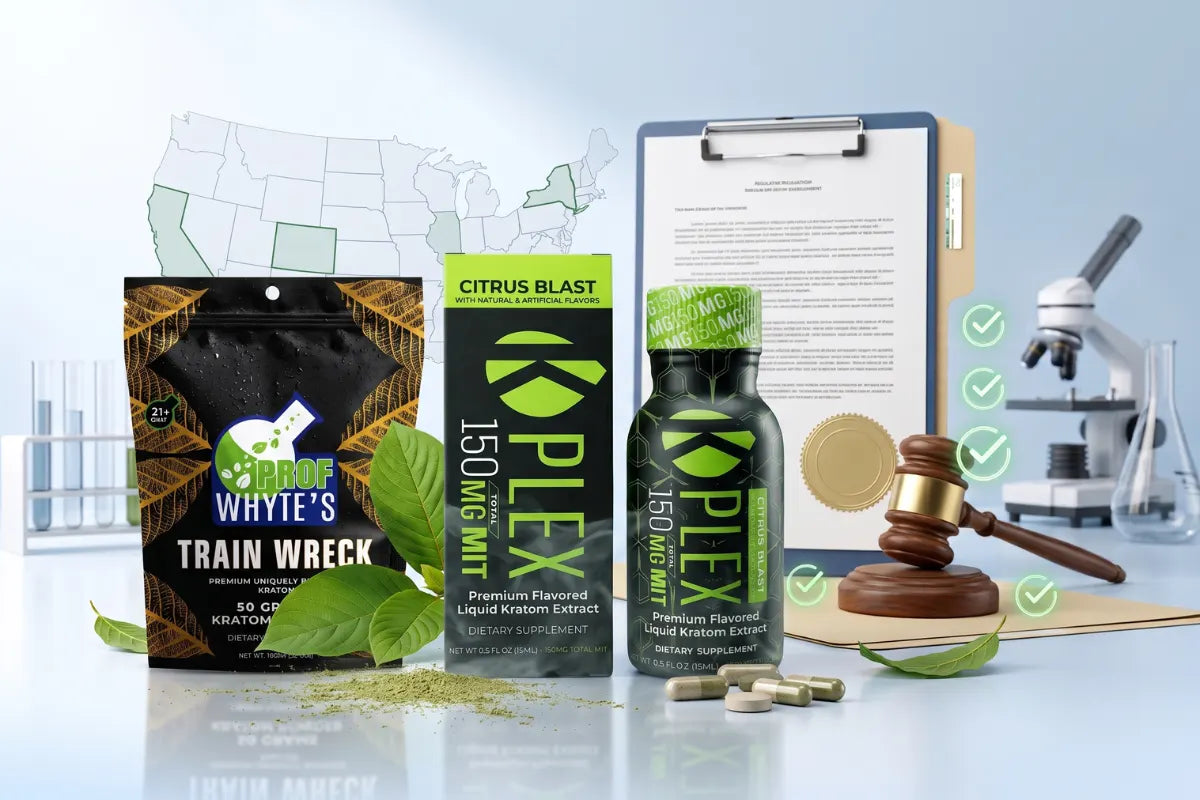
As of 2026, Kratom is not approved by the U.S. Food and Drug Administration (FDA) for any medical use, dietary supplement, or conventional food. The FDA continues to advise consumers against using Kratom products because of safety concerns and maintains enforcement actions against unlawfully marketed products.
At the same time, natural botanical Kratom remains federally unscheduled, while federal regulators have increased scrutiny of high-concentration and synthetic 7-hydroxymitragynine (7-OH) products, which are treated differently from natural Kratom.
If you're looking for the latest news on Kratom FDA status in 2026, this guide will help you understand the differences among FDA approval, federal regulation, and recent enforcement actions.
Key Takeaways
|
✔️ |
What You Should Know |
|
FDA approval |
Kratom is not FDA-approved for any medical use. |
|
Federal status |
Natural Kratom is not federally scheduled under the Controlled Substances Act. |
|
FDA position |
The FDA continues to warn consumers about potential safety risks and unlawful marketing. |
|
2026 update |
Federal agencies are focusing on high-concentration and synthetic 7-OH products, not all-natural Kratom. |
|
State laws |
Kratom laws still vary from state to state. |
Table Of Contents:
- What Is the FDA's Current Position on Kratom?
- Is Kratom FDA-approved?
- Does the FDA Ban Kratom?
- FDA vs. DEA: Understanding Their Roles in Kratom Regulation
- What Happened With 7-Hydroxymitragynine (7-OH) in 2026?
- Kratom’s Regulatory Timeline
- Additional Questions About Kratom FDA Status 2026
What Is the FDA's Current Position on Kratom?
Quick answer: The FDA does not approve or recognize Kratom as a safe or effective drug, dietary supplement, or food ingredient. The agency continues to advise consumers against using Kratom products and takes enforcement action against companies that market unlawful products or make unapproved health claims.
Here's what the FDA currently says:
- There are no FDA-approved prescription medications containing Kratom.
- There are no FDA-approved over-the-counter Kratom products.
- Kratom is not considered a lawful dietary supplement under the FDA's current interpretation.
- Kratom cannot legally be added to conventional foods under current FDA policy.
- The agency continues to issue warning letters and pursue enforcement against companies making unapproved therapeutic claims or selling unlawful products.
Here's a quick overview of the “FDA Kratom status 2026” to help you understand the current federal position before diving into the details.
FDA's Current Regulatory Position At A Glance
|
Topic |
FDA Position (2026) |
|
FDA-approved medicine |
❌ No |
|
Dietary supplement |
❌ Not recognized as lawful |
|
Conventional food ingredient |
❌ Not permitted under the current FDA position |
|
Approved medical use |
❌ None |
|
Ongoing enforcement |
✔️ Yes |
Is Kratom FDA-approved?
No, as of 2026, Kratom is not FDA-approved for treating any disease or medical condition.
This applies to:
- Powders
- Capsules
- Extracts
- Tablets
- Gummies
- Drink Mixes
- Liquid Shots
No Kratom product has completed the FDA's drug approval process or been approved as a prescription or over-the-counter medicine.
Why Isn't Kratom FDA-Approved?
The FDA's drug approval process requires manufacturers to demonstrate that a product is safe and effective for its intended use through scientific evidence and clinical data.
According to the FDA, Kratom has not met these requirements. As a result, the agency has not approved it for any medical use and continues to evaluate emerging research while warning consumers against using Kratom as a treatment for medical conditions.
FDA Approval Doesn't Always Mean Something Is Illegal
One of the biggest misconceptions is that "not FDA approved" automatically means "illegal."
That's not necessarily true.
Many products sold in the U.S. are not FDA-approved drugs, yet their legal status depends on other federal and state laws.
For Kratom, it's important to distinguish between FDA approval and federal drug scheduling.
FDA Approval vs Federal Legality
|
Question |
Answer |
|
Is Kratom FDA-approved? |
❌ No. The FDA has not approved Kratom for any medical use. |
|
Is Kratom federally illegal? |
❌ No. Natural botanical Kratom is not currently scheduled as a controlled substance under federal law. |
|
Can the FDA still regulate Kratom products? |
✔️ Yes. The FDA can take action related to product claims, labeling, imports, and products that violate federal regulations. |
|
Can states create their own Kratom laws? |
✔️ Yes. States can regulate, restrict, or prohibit Kratom regardless of its federal status. |
Check Kratom’s legality updates in detail with our guide “Is Kratom Legal? State By State Laws”
Does the FDA Ban Kratom?
Not exactly. The FDA has not classified natural kratom as a federally banned substance. However, the agency can take regulatory action against kratom products that it believes violate federal requirements.
One example is FDA Import Alert 54-15 for kratom products, which allows certain imported kratom products to be detained without physical examination when they appear to violate FDA regulations. This does not mean that all kratom products are federally banned, but it does show that the FDA actively monitors and regulates kratom imports.
It also has authority to:
- Issue warning letters,
- Maintain import alerts,
- Seize unlawfully marketed products,
- Work with U.S. Customs and Border Protection on imports, and
- Take enforcement action against companies violating federal law.
Whether a substance becomes a controlled drug under federal law is primarily handled by the Drug Enforcement Administration (DEA), often in coordination with the Department of Health and Human Services.
FDA vs. DEA: Understanding Their Roles in Kratom Regulation
One of the biggest sources of confusion is that the FDA and the DEA have different responsibilities. While both agencies are involved in federal oversight, they regulate Kratom in different ways.
FDA vs DEA At A Glance
|
FDA (Food and Drug Administration) |
DEA (Drug Enforcement Administration) |
|
Regulates foods, drugs, dietary supplements, and medical products |
Enforces the Controlled Substances Act (CSA) |
|
Reviews and approves prescription drugs |
Determines whether a substance should be scheduled as a controlled substance |
|
Issues warning letters to companies making unlawful health claims |
Investigates and enforces federal drug laws |
|
Maintains import alerts for products that may violate federal regulations |
Can temporarily or permanently schedule substances after following the required legal process |
|
Oversees product labeling, manufacturing, and marketing compliance |
Focuses on illegal trafficking and controlled substances |
In simple terms, the FDA determines how Kratom products can be marketed and sold, while the DEA determines whether a substance should be classified as a controlled drug under federal law.
What Happened With 7-Hydroxymitragynine (7-OH) in 2026?
One of the biggest regulatory developments in 2026 involved 7-hydroxymitragynine (7-OH), a compound associated with kratom.
In July 2026, the Drug Enforcement Administration (DEA) announced its intent to temporarily place certain 7-OH products and related substances into Schedule I of the Controlled Substances Act. The action focuses on products containing elevated concentrations of 7-OH and certain synthetic 7-OH-related compounds.
However, this action does not mean that all natural botanical kratom products have been federally scheduled.
The DEA specifically distinguished between:
|
Product Type |
2026 Federal Status |
|
Natural botanical kratom containing naturally occurring compounds |
Not the target of this temporary scheduling action |
|
High-concentration 7-OH products |
Subject to DEA scheduling action |
|
Synthetic 7-OH-related substances |
Targeted for federal control |
Why Is 7-OH Different From Natural Kratom?
Kratom (Mitragyna speciosa) naturally contains several alkaloids, including mitragynine and small amounts of 7-hydroxymitragynine (7-OH).
The recent federal focus is not on the existence of naturally occurring 7-OH in kratom leaves. Instead, it centers on products that contain elevated concentrations of 7-OH or chemically modified 7-OH-related substances.
According to the DEA, these actions are aimed at products that contain higher levels of 7-OH than what naturally occurs in botanical kratom.
Kratom’s Regulatory Timeline
To better understand the “Kratom FDA status 2026”, let's look at the major regulatory developments and what they mean for consumers and businesses.
|
Year |
Regulatory Development |
Why It Matters |
|
2014 |
FDA increased oversight of imported Kratom products through import alerts. |
Marked the beginning of stronger federal enforcement against imported products. |
|
2016 |
DEA announced plans to temporarily schedule Kratom alkaloids but later withdrew the proposal after receiving public comments. |
Natural Kratom remained federally unscheduled. |
|
2018 |
FDA issued additional public safety communications and warning letters to companies making unlawful health claims. |
Reinforced the agency's position that Kratom is not FDA-approved. |
|
2019–2025 |
The FDA continued to issue warning letters, maintain import alerts, and take action against companies violating federal regulations. |
The FDA's overall regulatory approach remained consistent. |
|
2026 |
Federal attention increased on certain high-concentration and synthetic 7-hydroxymitragynine (7-OH) products, while the FDA's position on natural botanical Kratom remained unchanged. |
Recent headlines largely relate to these products rather than a change in the FDA's stance on natural Kratom. |
So, What Has Actually Changed in 2026?
|
Topic |
2026 Status |
|
FDA approval of Kratom |
No change — Kratom remains unapproved. |
|
FDA consumer warnings |
No change — The FDA continues to advise consumers against using Kratom products. |
|
FDA import alerts |
Remain in effect for products that may violate federal law. |
|
Natural botanical Kratom |
Still federally unscheduled. |
|
High-concentration or synthetic 7-OH products |
Subject to increased federal scrutiny and enforcement. |
Key takeaway: The FDA's position on natural Kratom has not fundamentally changed in 2026. Most recent federal developments focus on specific 7-OH products, not on all Kratom products.
Additional Questions About Kratom FDA Status 2026
Does the FDA regulate Kratom imports?
Yes. The FDA can take action against imported Kratom products that violate federal regulations. This includes maintaining import alerts that allow certain shipments to be detained without physical examination when they appear to be non-compliant.
Can doctors prescribe Kratom in the United States?
No. Because Kratom is not an FDA-approved medication, healthcare providers cannot prescribe it as an approved treatment for any medical condition.
Does FDA approval affect how Kratom products are marketed?
Yes. Companies cannot legally market Kratom products with claims that they diagnose, treat, cure, or prevent diseases unless those claims have been reviewed and approved by the FDA.
Could the FDA's position on Kratom change in the future?
Federal policies can evolve as new scientific evidence, safety data, and regulatory reviews become available. Consumers and businesses should monitor official FDA announcements for the latest developments.
Can companies legally sell Kratom if it isn't FDA-approved?
In some states, yes. The absence of FDA approval does not automatically make a product illegal to sell. However, companies must comply with applicable federal and state laws, including restrictions on product labeling, marketing claims, and manufacturing practices. State-specific regulations may also affect whether Kratom products can be sold in a particular jurisdiction.
Brands like Professor Whyte's focus on providing product information and third-party lab testing details to help customers make more informed decisions about their Kratom products.
Why do some states regulate Kratom differently?
Although the FDA establishes certain federal regulatory policies, states have the authority to adopt their own laws regarding the sale and possession of Kratom. As a result, regulations can vary significantly across the United States.
Where can I find official updates about Kratom regulations?
The most reliable information comes from official government sources, including the U.S. Food and Drug Administration (FDA), the Drug Enforcement Administration (DEA), and state government websites for state-specific laws.
Disclaimer:
This article is for informational purposes only and should not be considered medical or legal advice. Kratom regulations and FDA policies may change over time. Always refer to official government sources for the most current information.