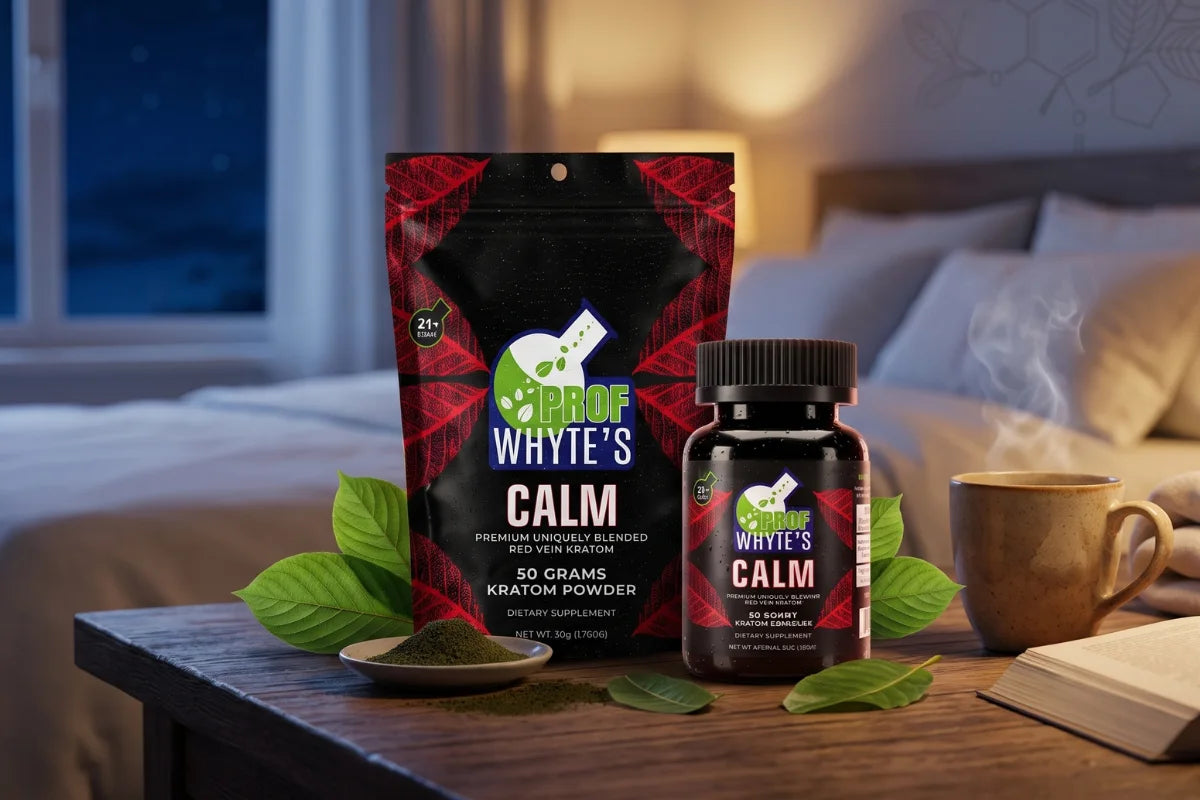
Can Kratom actually help you sleep, or is the connection based mostly on user experience? Kratom, also known as Mitragyna speciosa, is a Southeast Asian botanical containing naturally occurring alkaloids, with Mitragynine being the most prominent. Some users associate certain Kratom products, particularly red vein varieties, with nighttime use.
However, the evidence behind Kratom for sleep is still limited. Kratom has not been clinically established as a treatment for insomnia, and individual experiences can vary widely depending on the product, metabolism, frequency of use, and other factors.
In this guide, we’ll examine what research and user reports suggest about Kratom for sleep, why red vein Kratom is commonly linked with nighttime routines, and what you should understand about Kratom dosage, safety, and potential risks before drawing conclusions.
📖 Why You Need To Read This Guide
- See what research says about Kratom for sleep
- Understand the limits of using Kratom for insomnia
- Learn why red vein products are linked to nighttime use
- Review key dosage and safety considerations
Table Of Contents:
- Does Kratom Help With Sleep?
- Potential Benefits Of Kratom For Sleep
- Does Red Vein Kratom Support Sleep?
- What Should You Know About Kratom Dosage For Sleep?
- Tips For A Safer Kratom Nighttime Routine
- Frequently Asked Questions
- Final Thoughts
Does Kratom Help With Sleep?
The answer is not a simple yes or no. Some users report feeling more relaxed or drowsy after taking Kratom, which may make it easier for them to settle down at night. However, this does not mean Kratom reliably improves sleep quality or works the same way for everyone.
Individual experiences may vary depending on factors such as metabolism, body composition, product strength, frequency of use, health conditions, and the use of other substances or medications. In some cases, Kratom may also cause restlessness, discomfort, or disrupted sleep.
So, while some people associate Kratom with a calmer nighttime experience, its effect on sleep remains unpredictable.
Potential Benefits Of Kratom For Sleep
Some users report that Kratom may help them:
- Feel more settled before bed
- Manage discomfort and pain that interferes with sleep
- Fall asleep more easily
- Create a smoother transition into their nighttime routine
However, these benefits are based largely on individual reports and limited research. Kratom is not an approved treatment for insomnia, and responses can vary.
Does Red Vein Kratom Support Sleep?
Red Vein Kratom sleep is commonly discussed because red varieties are often associated with nighttime use. Some users include them in a Kratom nighttime routine to feel more settled before bed.
However, no Kratom strain is clinically proven to improve sleep, and individual responses can vary. Red Vein Kratom should therefore be viewed as a commonly marketed nighttime option, not a guaranteed sleep aid.
What Should You Know About Kratom Dosage For Sleep?
There is no clinically established Kratom dosage for sleep. Responses may change based on the amount taken, product strength, and frequency of use. Here is what you need to know:
How Kratom May Affect Sleep
|
Factor |
Possible Sleep Impact |
|
Amount Taken |
Lower amounts may feel more alerting, while higher amounts may cause drowsiness. |
|
Product Strength |
Alkaloid concentration can vary between products, making nighttime responses less predictable. |
|
Frequency of Use |
Regular use may contribute to tolerance, dependence, or changes in sleep patterns. |
Why Kratom May Not Be Suitable For Long-Term Sleep Support
What may seem helpful in the moment can become less predictable when Kratom is used repeatedly as part of a sleep routine.
Tolerance May Develop
Repeated use may reduce the same response over time, leading some users to take larger amounts and face greater risks.
Dependence Can Affect Sleep
Regular use may cause dependence. Stopping can lead to insomnia, restlessness, muscle discomfort, and other withdrawal symptoms.
Tips For A Safer Kratom Nighttime Routine
- Avoid treating Kratom as a substitute for insomnia care
- Do not combine it with alcohol, sedatives, or other substances
- Check product strength and lab-testing information
- Avoid increasing the amount when the response changes
- Stop and seek medical advice if sleep problems persist or worsen
Frequently Asked Questions
1. Is Kratom for insomnia effective for everyone?
No. Kratom for insomnia does not affect everyone the same way. Responses may vary based on product strength, metabolism, frequency of use, health conditions, and other substances or medications involved.
2. Which Kratom strain is considered the best Kratom for sleep?
Red Vein Kratom is most commonly associated with nighttime use. However, no strain has been clinically proven to be the best Kratom for sleep, and individual responses can vary.
3. Is it safe to combine Kratom with sleep medication?
No. Combining Kratom with sedatives, alcohol, sleep medications, or other substances may increase adverse-effect risks. A healthcare professional should assess possible interactions.
4. Can Kratom help you relax before bed?
Some users report feeling more settled or relaxed after using Kratom. However, this response is not universal and does not confirm improved sleep quality.
5. Can occasional Kratom use support better sleep?
Some occasional users report relaxation or easier sleep onset, but results vary. Even occasional use may cause unwanted effects or interactions.
Final Thoughts
As we wrap up, remember that Kratom for sleep is not a guaranteed solution. Before considering it, understand both the potential benefits and possible risks associated with Kratom use, review reliable research, consider your health conditions, and speak with a qualified healthcare professional when needed.
Disclaimer: This article is for educational purposes only and does not provide medical advice. Kratom is not an approved treatment for insomnia or other sleep disorders. Consult a qualified healthcare professional before using Kratom, especially if you take medications or have an existing health condition.
References:
- Singh, D., Narayanan, S., & Vicknasingam, B. (2016). “Traditional and Non-Traditional Uses of Mitragynine (Kratom): A Survey of the Literature.” Brain Research Bulletin, 126(1), 41–46. ScienceDirect
- Mun, C. J., et al. (2025). “Is Bedtime Use of Kratom (Mitragyna speciosa) a Sleep Aid or Disruptor? Examining Its Daily Effects and Individual Differences.” Drug and Alcohol Dependence. PubMed
- WebMD Editorial Contributors. “Kratom: Uses, Health Benefits, and Possible Risks.” WebMD. View source
- Swogger, M. T., Smith, K. E., Garcia-Romeu, A., Grundmann, O., Veltri, C. A., Henningfield, J. E., & Busch, L. Y. (2022). “Understanding Kratom Use: A Guide for Healthcare Providers.” Frontiers in Pharmacology, 13, 801855. PubMed Central
- Banyan Treatment Centers. “How Does Kratom Affect Sleep? Issues, Causes, and What to Do.” View source
- Mun, C. J., et al. (2025). “Kratom (Mitragyna speciosa) Use for Self-Management of Chronic Pain: Results From a Cross-Sectional Study.” The Journal of Pain. ScienceDirect
- Nova Recovery Center. “Red Kratom: Benefits and Risks Explained.” View source
- European Union Drugs Agency. “Kratom (Mitragyna speciosa) Drug Profile.” View source
- Elsevier. “Alkaloid—An Overview.” ScienceDirect Topics. View source
- Renew Health. “Kratom Withdrawal: Understanding Symptoms, Risks, and Pathways to Recovery.” View source
- Pathways Recovery. “Kratom and Alcohol: Dangerous Interactions.” View source
- Striley, C. W., Hoeflich, C. C., Viegas, A. T., Berkowitz, L. L., Matthews, E. G., & McCurdy, C. R. (2022). “Health Effects Associated With Kratom (Mitragyna speciosa) and Polysubstance Use: A Narrative Review.” Substance Abuse: Research and Treatment, 16. PubMed Central