

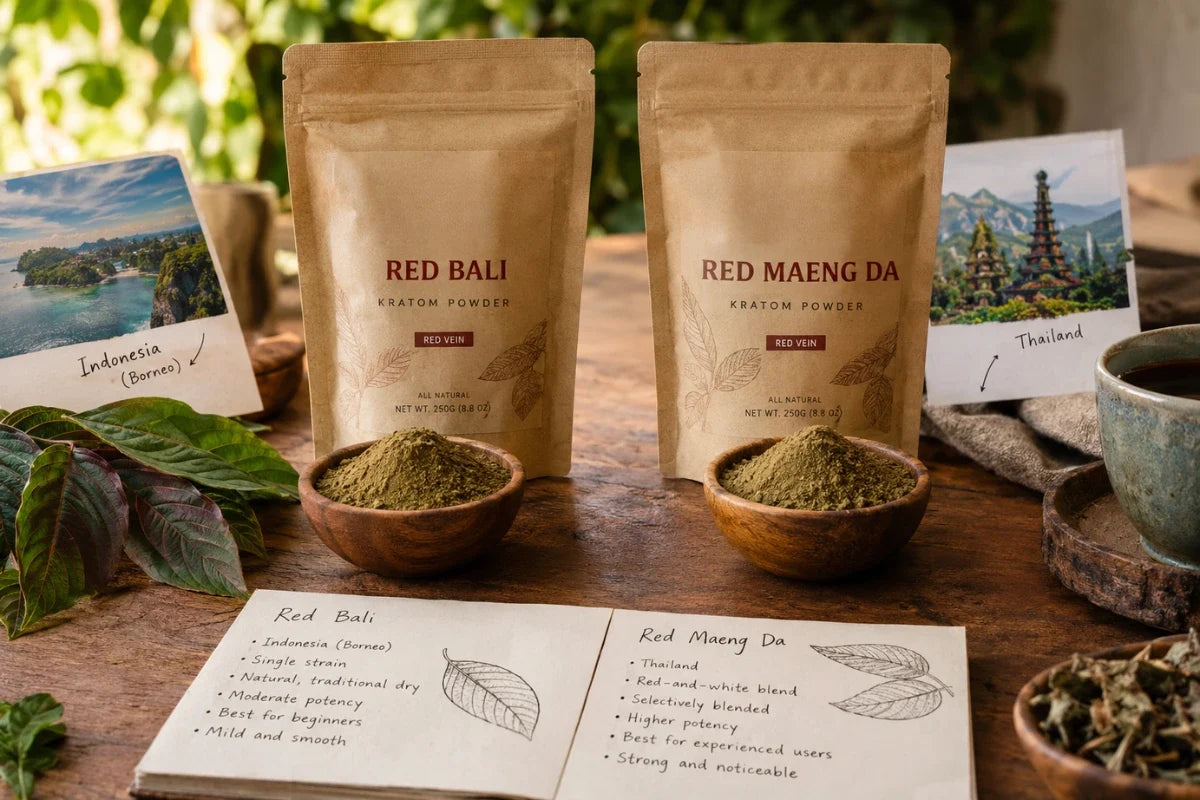
Red Bali and Red Maeng Da are two of the most popular red-vein kratom strains. Both come from the same plant, Mitragyna speciosa. But they differ in name origin, how they're grown and processed, and how strong they tend to feel.
In this guide, we compare Red vein Bali vs Maeng Da by origin, processing, strength, and best use. That way, you can choose what fits you best.
|
What Is Red Vein Kratom?
|
Table of Contents
Red Vein Bali vs Maeng Da Kratom: Key Differences
|
Feature |
Red Bali Kratom |
Maeng Da Kratom |
|
Origin |
Indonesia(Borneo) |
Thailand |
|
Type |
Single strain |
Red-and-white blend |
|
Cultivation |
Natural, traditional dry |
Selectively blended, stronger |
|
Potency |
Moderate |
Higher |
|
Best For |
Beginners |
Experienced users |
|
Effects |
Mild and smooth |
Strong and noticeable |
What Is Red Bali Kratom?
Red Bali Kratom is a single-strain Red vein variety made from mature Kratom leaves. Unlike blends, it is typically sold as one red variety.
It naturally contains alkaloids such as mitragynine. The exact levels can vary based on leaf maturity, sourcing, drying, and processing.
The name “Red Bali” is linked to Indonesia, where much of the world’s Kratom is produced. Although Bali is an Indonesian island, the name is historically associated with trade and shipping rather than meaning the leaves were necessarily grown on Bali itself.
To know more about this strain, you can check out our guide on Red Bali Kratom.
How Is Red Bali Kratom Processed?
Here’s how Red Bali Kratom is typically processed:
- Farmers carefully pick only fully grown leaves with clear Red veins by hand.
- The leaves are dried longer than green or white strains.
- Some farmers dry them in open air or sunlight; others use controlled rooms to manage heat and moisture.
- After drying, they grind the leaves into a fine powder and package them.
- Methods can differ between farms and sellers, so two bags labeled Red Bali may look or feel different.
What Is Red Maeng Da?
Red Maeng Da Kratom is a red-vein blend. Some versions combine mostly red-vein Kratom with smaller amounts of white or green-vein Kratom. It is considered a more potent and intense Kratom variety compared with Red Bali.
The name “Maeng Da” comes from Thailand, but it is not a growing region. Unlike Bali, Borneo, or Sumatra, no geographic region is called Maeng Da.
Maeng Da is also not a standardized strain. Its exact makeup can vary by vendor. Checking the ingredients, product details, and batch COA can give you a clearer picture of what is actually in the product.
For more details on its origins, characteristics, and naming, see our guide to Maeng Da Kratom.
How is Red Maeng Da typically produced?
Here’s how Red Maeng Da Kratom is typically processed:
- Growers pick mature, fully developed leaves with higher alkaloid content.
- Some plants are grafted to combine traits from different varieties for stronger results.
- Leaves are dried longer, like other red strains.
- Drying can be done in sunlight, indoor controlled rooms, or a mix of both.
- Many products blend Red Vein leaf with smaller amounts of White or Green Vein leaf.
- Exact ratios and finishing steps vary by vendor.
Red Bali & Red Maeng Da: The Overlap Nobody Mentions
Red Bali and Red Maeng Da may have different names, but their powders can look very similar. Red vein does not mean the finished Kratom powder will actually be red.
Both can appear greenish or brown after processing. Drying and processing can change the final color, so you cannot reliably tell Red Bali from Red Maeng Da just by looking at the powder.
Red Vein Maeng Da vs Bali: What To Choose?
When choosing Red Vein Bali Kratom vs Maeng Da, consider the product makeup, typical strength, and your Kratom experience.
Choose Red Maeng Da If:
- You already have some experience with Kratom.
- You prefer a product commonly sold as stronger.
- You are open to a blend of different vein colors.
- You are comfortable with formulas that can vary between vendors.
Choose Red Bali If:
- You are newer to Kratom.
- You prefer a product commonly sold as milder.
- You want a single-strain red variety.
- You want a simple product without a multi-vein blend.
Final Thoughts
Red Bali and Red Maeng Da may both fall under the Red vein category, but the names do not tell the whole story. Their sourcing, leaf selection, blending, drying, and processing can differ between vendors.
Instead of choosing by strain name alone, check the product details and batch-specific COA. These can give you a clearer picture of the alkaloid content and quality of the product you are comparing.
FAQs
What is the main difference between Red Bali and Red Maeng Da?
The main difference is how the two names are used in the Kratom market. Red Bali is commonly associated with Indonesian sourcing, while Red Maeng Da is a commercial name associated with Maeng Da products. Their processing and alkaloid profiles can also differ between vendors and batches.
Is Red Bali the same as Red Maeng Da?
No. Red Bali and Red Maeng Da are different commercial names used for red-vein Kratom products. Red Bali is associated with Indonesian sourcing, while Maeng Da is a commercial name that does not refer to a specific growing region. Their exact composition can also vary by vendor.
Why is Maeng Da called Maeng Da?
“Maeng Da” is a Thai term commonly translated as “pimp grade.” In the Kratom market, it is used as a product or variety name rather than a geographic designation. Unlike names such as Bali or Borneo, Maeng Da does not identify where the Kratom was grown.
How can you tell Red Bali from Red Maeng Da?
You generally cannot reliably identify Red Bali or Red Maeng Da from the powder's appearance alone. Processing can make different red-vein products look similar. Product labeling, sourcing information, and batch-specific laboratory results provide more useful information than color alone.


