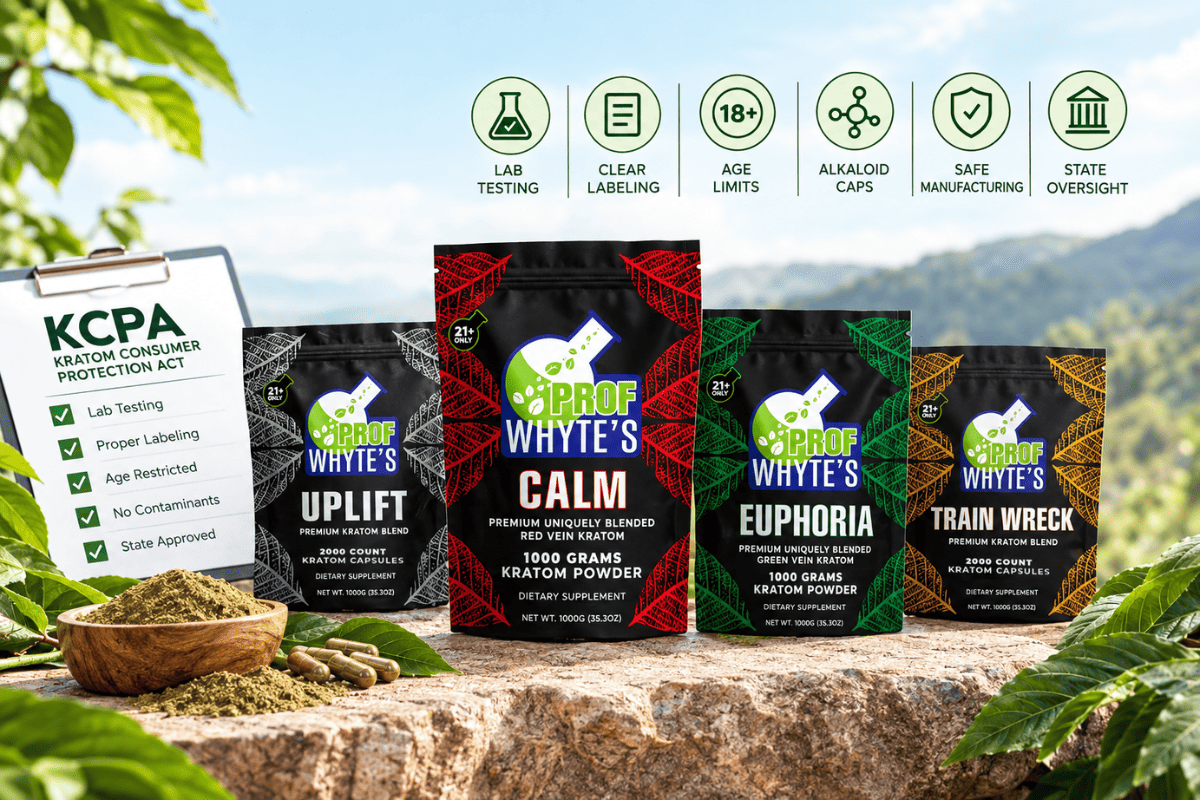
What Is The KCPA? The Kratom Consumer Protection Act Explained

The Kratom Consumer Protection Act (KCPA) is a state-level legislative framework in the U.S. created to regulate the Kratom market and improve consumer safety without relying on a total ban. It gives states rules and standards for testing, labeling, manufacturing, and distributing Kratom products.
In this guide, we’ll break down what the Kratom Consumer Protection Act does, why it was introduced, the main KCPA requirements, which states have adopted these laws, and how they affect both consumers and Kratom businesses.
Key Takeaways
- The Kratom Consumer Protection Act (KCPA) is a state-level model law, not one federal rule.
- It was created to regulate Kratom instead of banning it outright.
- KCPA laws commonly address lab testing, labeling, age limits, alkaloid limits, and manufacturing standards.
- Each state can change the model, so KCPA requirements vary by location.
- Consumers may get better product transparency, clearer labels, and stronger quality checks.
-
Vendors face stricter compliance, testing, labeling, and recordkeeping responsibilities.
Table Of Contents
- What Is the Kratom Consumer Protection Act (KCPA)?
- Why Was the KCPA Created?
- What Does the Kratom Consumer Protection Act Do?
- KCPA vs Kratom Ban: How Are They Different?
- Which States Have Passed KCPA Regulations?
- Why KCPA Compliance Matters Beyond Legal Requirements
- How Does KCPA Affect Kratom Consumers?
- How KCPA Impacts Kratom Vendors
- The Future of Kratom Legislation
- Final Thoughts
- FAQs
What Is The Kratom Consumer Protection Act (KCPA)
It is a model regulatory framework proposed and promoted by the American Kratom Association that states can adopt and adapt through their own legislation.
Instead of allowing states to ban Kratom completely, the AKA works with state lawmakers to pass the KCPA as a framework to legally regulate the market, ensure consumer safety, and hold vendors accountable.
Because Kratom laws differ significantly across the country, it is also useful to understand Kratom legality by state.
Why Was the KCPA Created?
Before states began adopting KCPA Kratom laws, Kratom regulation varied considerably by jurisdiction. Some states and local governments had restrictions in place, while others had few or no Kratom-specific requirements at all. That inconsistency, paired with a largely unregulated market, is what eventually pushed lawmakers to act.
1. No Rules Created Real Risks: Kratom was widely sold with no testing, no labeling standards, and no age restrictions in most places.
2. Contamination and Bad Practices Sparked Alarm: Tainted products and misleading vendor claims raised public concern and pushed several states toward outright bans.
3. A Practical Alternative to Bans: The American Kratom Association created the KCPA to regulate the market, protecting consumers while keeping Kratom available to adults.
What Does the Kratom Consumer Protection Act Do?
The KCPA sets clear rules that Kratom products and sellers must follow to protect consumers.
- Sets age limits: Only adults can buy or possess Kratom. The minimum age is 18 or 21, depending on the state.
- Bans contamination: Makes it illegal to sell Kratom mixed with synthetic opioids (like fentanyl) or dangerous contaminants such as Salmonella and heavy metals.
- Caps alkaloid levels: Limits 7-Hydroxymitragynine (the plant’s most potent compound) to less than 2% of total alkaloids to prevent overly strong, high-risk extracts. For more background, see this guide to Kratom alkaloids.
- Requires lab testing: Manufacturers must have independent third-party labs test their products to prove purity before they can be sold.
- Requires clear labeling: Packaging must clearly show the product’s origin, ingredients, usage warnings, and exact amounts of active alkaloids.
- Gives states oversight power: A state agency (such as the Department of Agriculture) registers vendors, runs random checks, and can fine or revoke licenses for violations.
KCPA vs Kratom Ban: How Are They Different?
A Kratom ban generally prohibits the possession, sale, distribution, or other activities involving Kratom, depending on the specific jurisdiction.
The KCPA takes the opposite approach. Instead of banning Kratom, it keeps the plant legal for adults while requiring vendors to meet clear standards of lab testing, accurate labeling, alkaloid limits, and age restrictions before products can be sold.
Learning how to read a Kratom COA can help you understand what these laboratory reports actually show.
Which States Have Passed KCPA Regulations?
Kratom’s legal status varies widely by state. The KCPA was created to bring some consistency to this patchwork.
As of 2026, 20 states have passed some version of the KCPA; a few have banned Kratom completely, and the rest either have bills pending or allow sales with no statewide testing, labeling, or age rules.
States with KCPA in Effect:
- Utah (first to pass, 2019)
- Arizona
- Georgia
- Oklahoma
- Nevada
- Oregon
- Colorado
- Virginia
- West Virginia
- Kentucky
- Maryland
- Florida
- Texas
- Mississippi
- South Carolina
- Nebraska
- New York
- South Dakota
- Missouri
- Rhode island
Why KCPA Compliance Matters Beyond Legal Requirements
KCPA compliance is about more than avoiding fines or product seizures. In a high-risk industry, it directly affects a brand’s survival, financial stability, and ability to earn long-term customer trust.
Meeting the legal minimum is the baseline. True compliance acts as a business asset that protects against major operational failures. In short, KCPA compliance is the floor. Treating it as a ceiling helps build a more secure, trusted, and lasting business.
How Does KCPA Affect Kratom Consumers?
For consumers, the KCPA creates a more structured Kratom market by giving states a way to set clear rules for products and sellers. It does not guarantee that every product is compliant. Still, it can give buyers more information and stronger protections than an entirely unregulated market.
Consumers may see:
- More testing requirements
- Clearer product labels
- Age restrictions
- More vendor accountability
- Legal access under regulation
- Better product transparency
- Clearer signs of compliance
How KCPA Impacts Kratom Vendors
KCPA sets clear, enforceable standards vendors must meet before they can legally sell a product: lab testing, accurate labeling, and adherence to Good Manufacturing Practices.
This raises the bar across the board, pushing companies to invest in better sourcing, quality control, and manufacturing processes to stay compliant.
The Future of Kratom Legislation
Kratom laws in the U.S. are still changing, and states are taking very different approaches. Some are moving toward stricter bans, while others are expanding KCPA-style rules with more oversight for vendors and products.
At the federal level, regulators are paying closer attention to high-potency and concentrated 7-OH products. Until there is one clear national framework, Kratom laws will likely remain different from state to state, so both consumers and vendors need to keep checking current rules.
For the latest federal developments, see the Kratom FDA status and 7-OH regulations guide.
Final Thoughts
The Kratom Consumer Protection Act gives states a way to regulate Kratom without relying on a complete ban. Its main role is to clarify market rules while improving transparency and accountability.
Because KCPA laws differ from state to state, both consumers and vendors should understand the rules that apply where they live or operate. As Kratom legislation continues to change, checking current state and local laws remains essential.
FAQs
Does KCPA apply to online Kratom purchases, or only in-store sales?
Most state KCPA laws apply to any sale within that state, including online orders shipped there. The product still has to meet the same testing, labeling, and age-verification standards regardless of how it's purchased.
If I buy KCPA-compliant Kratom in one state, is it legal to bring it into a state with a ban?
No. Compliance in the state of purchase doesn't override the law where you're carrying or using the product. Crossing into a banned state with Kratom, even a tested and labeled one, can still be a legal violation.
Does a KCPA law guarantee every product sold in that state is safe?
No. It sets a legal minimum and gives regulators enforcement power. However, it doesn't guarantee every vendor complies in practice. Checking a specific product's COA is still worth doing even in a regulated state.
Who enforces KCPA laws?
Enforcement depends on the state. Oversight may fall to a Department of Agriculture, health department, or another state regulatory agency.
Can local governments ban Kratom even if the state allows it?
Yes. Some cities and counties may have local restrictions or bans even when Kratom is legal statewide. Always check both state and local rules.
Is Kratom FDA approved?
No. Kratom is not FDA-approved as a drug or dietary supplement. A product meeting KCPA requirements in a given state does not mean it has FDA approval; the two are separate types of oversight.