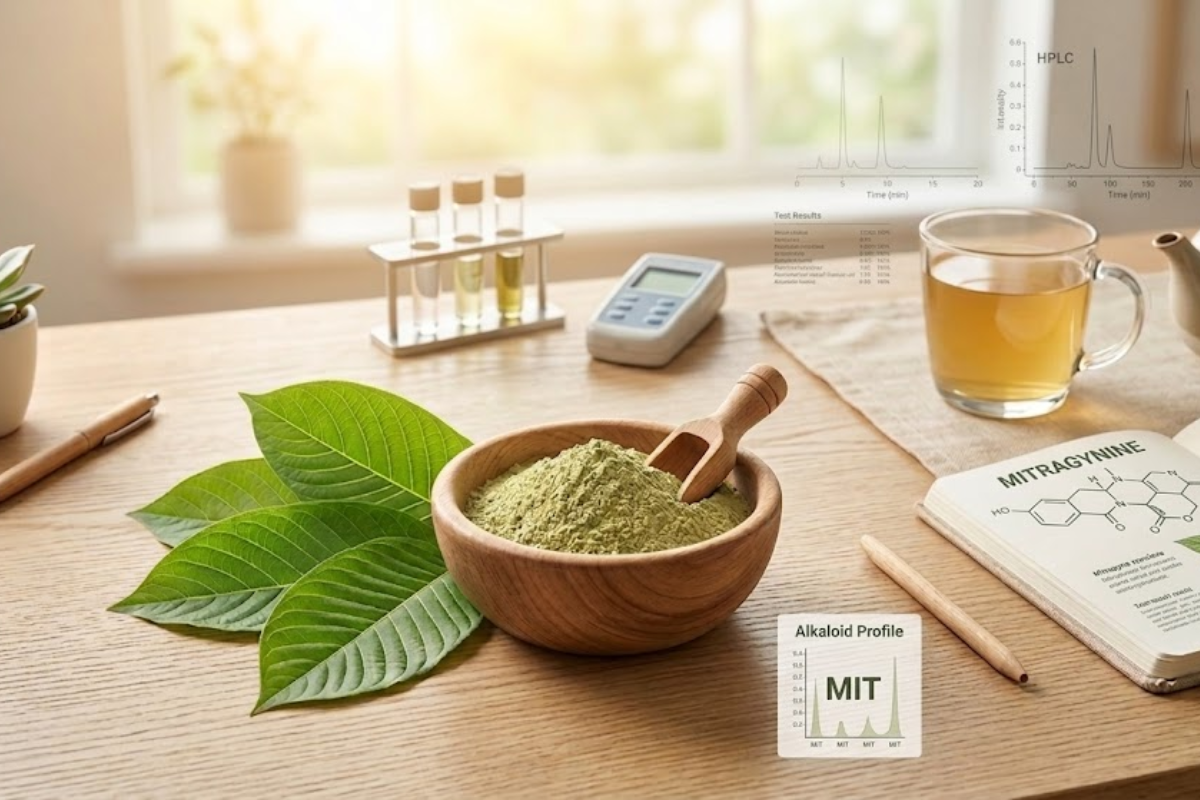
Mitragynine, often abbreviated as MIT, is the most abundant naturally occurring alkaloid found in the Kratom plant. When people discuss Kratom’s chemical makeup, effects, or product labeling, they are almost always referring to mitragynine in some form.
Understanding what mitragynine is, how it works in the body, and how it appears on Kratom labels is essential for anyone researching Kratom from an educational or consumer standpoint. This guide explains mitragynine in clear, practical terms without exaggeration, helping readers understand why MIT is considered the primary Kratom alkaloid.
What Is Mitragynine and Why Is It Called MIT?
Mitragynine is a naturally occurring alkaloid found in the leaves of Mitragyna speciosa, the tropical tree commonly known as Kratom. It is classified as the dominant Kratom alkaloid because it makes up the largest percentage of total alkaloid content in most Kratomleaf samples.
The abbreviation “MIT” is widely used in scientific literature, lab reports, and Kratom product testing to shorten the compound name. This shorthand has also become standard in Certificates of Analysis and product labels, making MIT a familiar reference point for consumers reviewing Kratom potency and composition.
In most Kratom products, mitragynine represents the foundational alkaloid upon which the rest of the plant’s alkaloid profile is built.
The History of When MIT Was Discovered in 1921
Mitragynine was first isolated and identified in 1921 by researchers studying Southeast Asian medicinal plants. Early pharmacognosy research focused on understanding the chemical compounds responsible for Kratom’s traditional use in regions such as Thailand and Malaysia.
At the time of discovery, mitragynine stood out due to its prevalence in the leaf and its distinct molecular structure compared to alkaloids found in other botanical species. Over the decades, mitragynine became the focal point of Kratom research, as scientists recognized it as the compound most consistently present across different regions and harvests. Know “The Science behind Kratom leaves” by reading what the sources mentioned in their articles here.
Modern analytical techniques such as chromatography and mass spectrometry have since confirmed mitragynine’s role as the dominant alkaloid in Kratom.
How Does Mitragynine Work When Inside the Body?
Mitragynine interacts with multiple biological pathways once metabolized, which is one reason Kratom is often described as pharmacologically complex. Rather than acting through a single mechanism, MIT influences several receptor systems simultaneously.
Research indicates that mitragynine primarily interacts with opioid receptor systems as a partial agonist, meaning it activates receptors without fully overstimulating them. This partial interaction is one of the reasons mitragynine behaves differently from many synthetic compounds.
In addition to opioid receptor activity, mitragynine has been observed to influence adrenergic pathways, which may help explain its varied dose dependent responses. Importantly, mitragynine does not function in isolation. Its effects are influenced by the presence and ratios of other Kratom alkaloids.
The Proper Elaboration Between MIT and Other Kratom Alkaloids
While mitragynine is the most abundant alkaloid in Kratom, it is not the only active compound present in the leaf. Kratom contains more than 40 identified alkaloids, many of which interact with the same receptor systems in subtle but meaningful ways, read more about Kratom Alkaloids list here.
Mitragynine serves as the primary driver of Kratom’s alkaloid profile, while secondary and minor alkaloids help shape how that activity is experienced. These supporting alkaloids may influence duration, balance, and receptor modulation rather than producing dominant effects on their own.
This layered interaction explains why products with similar mitragynine levels can feel different depending on their full alkaloid composition.
|
Alkaloid Name |
Approximate Share of Total Alkaloids |
Primary Role in the Alkaloid Profile |
|
Mitragynine (MIT) |
60–70 percent |
Core alkaloid that defines overall potency and baseline activity |
|
8–10 percent |
Supports smoothness and balance within the alkaloid profile |
|
|
6–8 percent |
Contributes to modulation and overall alkaloid interaction |
|
|
0.5–1.5 percent |
Alters receptor binding behavior relative to MIT |
|
|
Trace amounts |
Minor modulatory influence |
How the Levels of MIT Vary Based on KratomStrains
Mitragynine levels vary naturally across Kratomstrains due to differences in leaf maturity, harvest timing, regional growing conditions, and post-harvest processing. Strain names do not indicate unique alkaloids but rather different alkaloid ratios, with MIT levels shifting accordingly.
Understanding how MIT varies by strain category helps connect alkaloid science to real-world product selection.
Typical MIT Levels by Kratom Strain Category
|
Kratom Strain Category |
Typical MIT Level |
Explanation |
|
Red Vein Kratom |
Moderate (1.0–1.6%) |
Red vein leaves are harvested later in maturity, often showing slightly lower mitragynine percentages but higher presence of secondary alkaloids |
|
Green Vein Kratom |
Moderate to High (1.3–1.8%) |
Green vein strains often display balanced alkaloid profiles with stable mitragynine levels and consistent batch performance |
|
White Vein Kratom |
Higher (1.6–2.2%) |
White vein leaves are typically harvested earlier, which is associated with higher mitragynine concentration relative to total alkaloids |
|
Blended Strains |
Variable |
Blends combine multiple vein types, resulting in averaged or intentionally adjusted MIT levels |
|
Extract-Based Products |
Highly Variable |
MIT levels depend on concentration method and whether the extract is standardized |
Why Do These Differences Matter?
Higher mitragynine percentages do not automatically indicate a better or stronger product. Instead, they reflect how the leaf was grown and processed, as well as how its alkaloids are balanced.
For example:
- A white vein strain may test higher in MIT but feel less balanced due to lower secondary alkaloid presence
- A red vein strain may test lower in MIT but offer a more rounded alkaloid profile
- A green vein strain often sits between the two, both chemically and experientially
This reinforces why strain selection should be informed by alkaloid composition, not just color naming conventions. For more information about these strains, read PubMed article here.
What Is the Meaning of MIT % on Product Labels?
MIT percentage refers to the proportion of mitragynine present in a Kratom product relative to its total weight. This value is typically determined through laboratory testing and is listed on Certificates of Analysis or product labels, for example, you can check the lab reports by Professor Whytes here.
For example, a product labeled with 1.5 percent MIT means that mitragynine makes up 1.5 percent of the tested sample by weight. This figure helps consumers compare products more objectively than relying on strain names alone.
Understanding how to read lab reports allows buyers to evaluate potency, consistency, and transparency across different products.
The Right Dosage of MIT and Safety Considerations
There is no universally established dosage standard for mitragynine, as individual response varies based on body chemistry, experience level, and product composition. Mitragynine content should always be evaluated in the context of total alkaloid balance rather than treated as a standalone metric.
Safety considerations include starting with lower exposure levels, avoiding frequent escalation, and choosing products with verified lab testing. Products that clearly disclose mitragynine content allow consumers to make informed decisions and reduce uncertainty. Read the complete guidebook on the dosage and safety of Kratom.
Kratom and its alkaloids are not FDA approved, and regulatory standards differ by jurisdiction. Responsible use begins with accurate information and transparency, read information by Journals Library.
Frequently Asked Questions
Is mitragynine legal?
Mitragynine itself is not scheduled at the federal level in the United States, but Kratom legality varies by state and locality. Always verify local regulations before purchasing or using Kratom products.
Is mitragynine the same as Kratom?
No. Mitragynine is one alkaloid found within Kratom. Kratom is a botanical material containing many alkaloids that work together.
Why do some products list MIT percentages?
MIT percentages help communicate alkaloid concentration and allow consumers to compare products using objective data rather than marketing terms.
Does higher MIT mean better quality?
Not necessarily. Quality depends on overall alkaloid balance, testing standards, sourcing, and product transparency.
Can MIT levels change between batches?
Yes. Natural variation in harvesting and processing can cause mitragynine levels to fluctuate between batches.
Conclusion
Mitragynine is the primary Kratom alkaloid and the most important compound to understand when evaluating Kratom products. Its role in Kratom’s chemistry, labeling, and consumer education makes it central to informed decision making.
By learning what mitragynine is, how it functions, and how it appears on product labels, readers gain a clearer understanding of Kratom beyond strain names or anecdotal descriptions.
Disclaimer
This content is for informational purposes only and does not constitute medical or legal advice. Always review local laws and consult qualified professionals when evaluating botanical products.