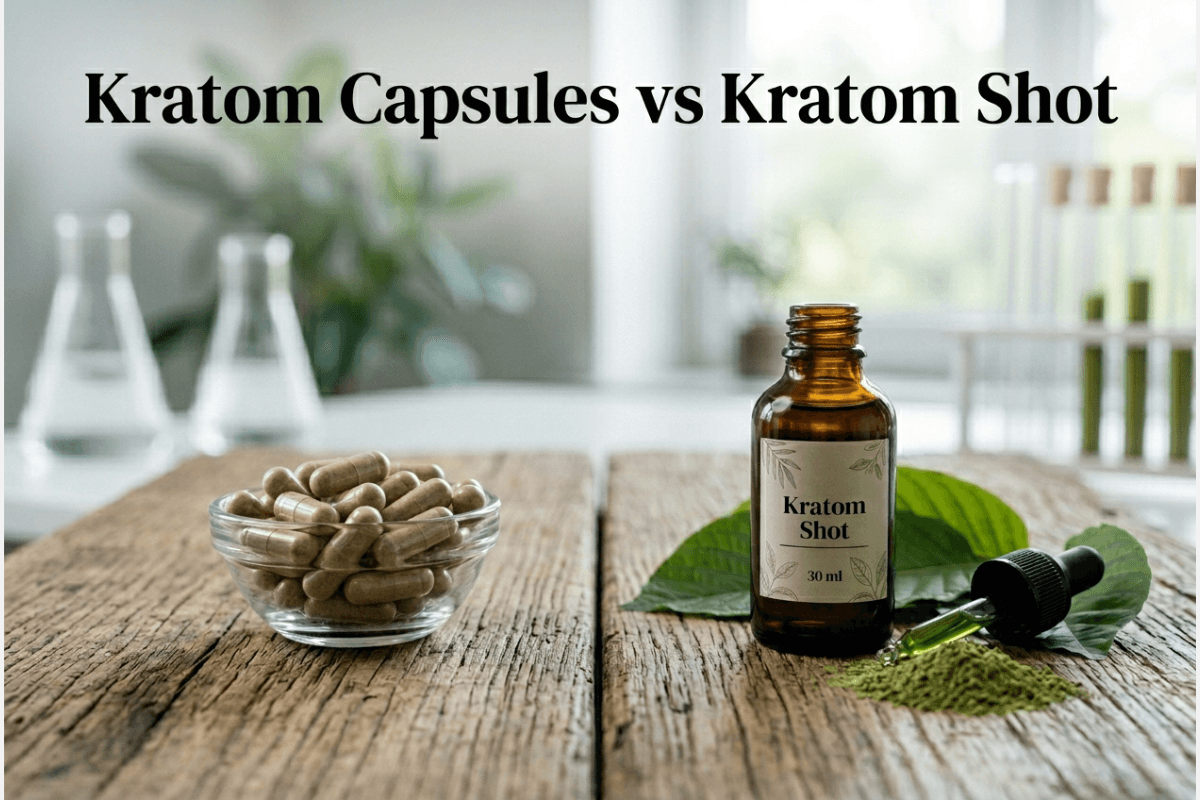
When people compare kratom shots vs capsules, they’re usually trying to understand how different kratom formats vary in structure, convenience, and handling — not which one is universally better.
Both capsules and shots are designed to make kratom easier to use than raw powder, but they achieve this in different ways:
Kratom capsules contain measured amounts of kratom powder or extract powder sealed in a capsule.
Kratom shots are liquid formats made using kratom extract, blended into a ready-to-consume bottled form.
This guide explains the difference between kratom shots and capsules in a clear, educational way to help you decide which format aligns better with your preferences.
Kratom Capsules vs Liquid Shots: Core Differences
The primary difference between kratom capsules vs liquid shots lies in how the kratom material is delivered.
Form & Composition
Capsules: Solid format containing kratom powder or extract powder inside a dissolvable shell.
Liquid shots: Kratom extract dissolved into a liquid base, sometimes with added flavoring or stabilizers.
The difference between kratom shots and capsules is structural and practical — not about claims, strength, or performance.
Are Kratom Shots Better Than Capsules?
There is no universal answer.
The question “are kratom shots better than capsules?” depends on what you value most:
Choose capsules if you prefer a tasteless, consistent, and compact format.
Choose liquid shots if you prefer a ready-to-consume liquid format with flexible serving options.
Neither format is inherently superior — they are simply different delivery systems for kratom.
Liquid Kratom vs Capsules: Which Fits Your Routine?
Consider these neutral, practical factors:
Lifestyle
On-the-go convenience with no taste → capsules
Liquid format with portion flexibility → shots
Handling
Prefer compact storage → capsules
Prefer ready-to-drink format → shots
Consistency
Want standardized servings → capsules
Want adjustable amounts → shots
FAQs
1: What is the main difference between kratom shots and kratom capsules?
Kratom shots are liquid products that are ready to consume, while kratom capsules contain powdered kratom in pre-measured servings. Shots offer convenience and faster consumption, whereas capsules provide a tasteless option.
2: Are kratom capsules easier to use than kratom shots?
Kratom capsules are simple to take and require no measuring, making them a convenient choice for many users. However, kratom shots may be preferred by those looking for a ready-to-drink format.
3: Which is more cost-effective: kratom shots or kratom capsules?
Kratom capsules are often more economical for regular use because they typically provide more servings per package. Kratom shots may cost more per serving due to their convenience and formulation.
Final Thoughts
Choosing between kratom capsules vs shots comes down to format preference, handling style, and personal routine.
Capsules offer simplicity and consistency. Shots offer flexibility and liquid convenience.
Understanding how each format is structured makes it easier to decide which one fits your needs — without relying on claims or comparisons that go beyond format and design.
Disclaimer
This content is provided for educational and informational purposes only. It is not intended to offer medical advice, diagnose conditions, or recommend treatment of any kind. Individual experiences with kratom formats may vary. Always review product labels, verify third-party lab testing, and comply with local, state, and federal regulations before purchasing or using kratom products. Keep all kratom products out of reach of children and pets, and use them responsibly.
FAQ
Can beginners choose either kratom shots or kratom capsules?
Both kratom shots and kratom capsules are widely available in the market. The right choice depends on your preferred format, convenience, product ingredients, and overall buying preferences.
What should I look for when buying kratom shots or capsules?
Look for products from reputable brands that provide third-party lab testing, clear ingredient labels, manufacturing details, and transparent product information before making a purchase.
Do kratom shots and kratom capsules come in different varieties?
Yes. Kratom shots and capsules are available in a variety of formulations, including powder-based products and concentrated extracts. Many brands also offer different serving sizes and product strengths to suit various preferences.
Nyla Collum is a Tampa-based writer with 5 years of experience creating content on kratom, botanical products, and wellness. She is passionate about turning complex topics into clear, honest, and easy-to-understand blogs that genuinely help readers. Her work focuses on product education, wellness trends, and practical insights that build trust and help people make informed choices.
Kratom chewables are flavored, pre-measured consumer products such as soft gummies or compressed tablets, infused with Kratom Extract or leaf material designed to mask the plant's natural bitterness. This guide breaks down what chewables are, how they differ from capsules, and what to check before buying.
Table of Contents
What Are Kratom Chewables?
Are Kratom Chewables the Same as Kratom Tablets?
Chewables vs Other Kratom Formats
Are Kratom Chewables Legal?
What to Look for When Buying Kratom Chewables
Kratom Chewables Alternatives
Final Thoughts
FAQs
Key Takeaways
Kratom chewables are flavored, pre-measured formats available as gummies or compressed tablets made with Kratom powder or extract.
Chewables focus on convenience and portability because they come in individual pieces and require no mixing or preparation.
Kratom chewables are different from traditional tablets and capsules because they often include flavoring, sweeteners, binders, or gelling ingredients to create their texture and taste profile.
Product quality depends on more than the format alone. Check the Kratom base (powder or extract), alkaloid information, ingredient list, third-party lab testing, batch details, and manufacturing standards before buying.
Kratom chewables are not regulated the same way everywhere. Federal rules do not ban Kratom, but state and local laws vary, so buyers should confirm current regulations where they live. One should also check if the products align with AKA’s quality standards.
Chewables are one of several Kratom formats available. Powder, capsules, shots, and beverages each differ in preparation, packaging, and formulation.
What Are Kratom Chewables
Kratom chewables are pre-formed, processed products infused with kratom extract or powder that are designed to be chewed rather than swallowed whole or mixed into liquids.
They are designed to be chewed and may include additional ingredients such as sweeteners, flavoring, binders, or gelling agents, depending on the product.
The term Kratom chewable covers several product types rather than a single standard formula, so exact ingredients and formulation can vary by brand and format.
Types Of Kratom Chewable Products
Kratom chewable products primarily fall into two main categories based on their formulation, active alkaloid, and potency:
1. Kratom Gummies
Active Compound: Standard mitragynine extract.
Dose Range: 15–50 mg of mitragynine per gummy.
Onset Time: 30–60 minutes.
Details: These are gelatin or pectin-based fruit-flavored edibles. They mask the bitter taste of raw leaf powder and offer a slower, measured release through standard digestion.
2. Standard Kratom Chewable Tablets
Active Compound: Concentrated mitragynine extract.
Dose Range: 50–100 mg of mitragynine per tablet.
Onset Time: 20–40 minutes.
Details: Unlike standard tablets meant to be swallowed whole, these are compressed and designed to be chewed. Chewing allows partial buccal mucosal absorption (absorption through the lining of the mouth) mixed with saliva before swallowing, leading to a slightly faster onset.
Key Characteristics Of Kratom Chewables
Here are the key characteristics of Kratom chewables:
Flavor Masking: Raw kratom is notoriously bitter and earthy. Chewables combine kratom extracts with sweeteners, fruit flavorings, and citric acid to heavily mask this unpleasant taste.
Texture Variations: They primarily come as soft gelatins or pectin-based gummies, though some brands offer compressed, crunchy chewable tablets that dissolve in the mouth.
Discretion and Portability: They look like standard candy or vitamins, making them easy to transport and consume in public without the mess of measuring raw powder.
Extract-Based Potency: Unlike standard raw leaf capsules, most chewables are infused with highly concentrated mitragynine extracts rather than raw powder. Because they utilize extracts, the standard dosage often ranges from 15mg to 50mg of mitragynine per piece.
Pre-Measured Dosing: Each individual piece contains a fixed, standardized amount of alkaloids, eliminating the need for scales or measuring scoops.
Delayed, Extended Onset: Because the chewable must pass through the digestive system to release the active compounds, the onset of effects is typically slower than drinking liquid kratom tea, usually taking 30 to 60 minutes to activate but providing longer-lasting effects.
What Ingredients Are Used In Kratom Chewables?
Kratom chewables and gummies contain a base of active kratom plant extracts mixed with standard candy ingredients like gelling agents, sweeteners, and flavorings
Common ingredients may include:
Kratom powder or extract: Some chewables use ground Kratom leaf, while others use concentrated extract as the primary Kratom ingredient.
Binding agents: These help hold compressed tablets or chews together and maintain their shape.
Sweeteners and flavoring: Ingredients such as sugar, corn syrup, tapioca syrup, or added flavoring may be used to balance the natural taste of Kratom. They are added especially in a kratom chewable extract, where the concentrated leaf material can taste stronger.
Gelling ingredients: Gummies commonly use gelatin or pectin to create their soft, chewy structure.
Acids and stabilizers: Ingredients such as citric acid or malic acid may be added to support flavor, texture, or product stability.
Why Do People Choose Kratom Chewables?
Here are some common reasons why people choose Kratom chewables:
No mixing or preparation: Most chewables come ready to use without measuring or mixing powder into a drink.
Individual pieces: Manufacturers typically package them as separate pieces with product information listed on the label.
Compact packaging: Gummies and tablets usually come in small bottles, pouches, or packs that are easy to store.
Alternative to capsules: Chewables provide another option for people who prefer not to swallow capsules.
Flavored formats: Many chewables, including kratom extract gummies, include added flavoring, which makes them different from plain Kratom powder.
Potential Downsides Of Kratom Chewables
Here are some potential downsides to consider with Kratom chewables:
Dependence: Regular Kratom use can lead to physical dependence and tolerance. Concentrated kratom chewables may make it harder to keep track of how much you're taking.
Withdrawal: Stopping regular use may cause symptoms such as muscle aches, sleep problems, irritability, or cravings.
Contamination concerns: Poor manufacturing practices can increase the risk of unwanted contaminants.
Added ingredients: Chewables may contain sweeteners, flavoring agents, binders, or other ingredients; check the label.
Potential interactions: Kratom may interact with certain medications, alcohol, or other substances.
Are Kratom Chewables The Same As Kratom Tablets?
No. Kratom chewables and Kratom tablets are not the same, although some brands may use the terms interchangeably. Chewable kratom tablets are pressed like standard tablets, but they are made to be chewed rather than swallowed whole. The main differences are:
Feature
Kratom Chewables
Kratom Tablets
Texture
Soft, gummy, or chalky
Hard and compressed
Ingredients
Often include sweeteners, flavors, gelatin, pectin, or binders.
Fewer or no added ingredients.
Taste
Flavored to reduce bitterness.
No added flavor.
Kratom Chewables vs Other Kratom Formats
Kratom chewables offer a convenient alternative, but they’re not the only format available. Here’s how chewables compare with powder, capsules, shots, and seltzers across the features that matter most.
Feature
Chewables
Capsules
Powder
Shots
Beverages
What it is
Kratom extract infused into chewable candies, gummies, or pressed mint-like tablets.
Raw leaf powder or concentrated extract sealed inside a dissolvable gelatin or veggie shell.
Crushed, dried Mitragyna speciosa leaves ground into a fine raw powder
Highly concentrated liquid extract sold in small, single-serving bottles.
Ready-to-drink carbonated water or juices infused with water-soluble kratom extract.
Effect time
Fast (15–30 mins)
Slow (30–60 mins )
Moderate (20–40 mins)
Rapid (10–20 mins)
Fast to Moderate (15–30 mins)
Taste masking
Excellent; flavored to hide kratom's natural bitterness.
Perfect; completely tasteless unless a capsule breaks.
Poor; intensely bitter, earthy, and gritty.
Fair to Poor; often strongly flavored but highly bitter.
Good to Excellent; diluted and carbonated with fruit flavors.
Portability
Highest; discreet, pre-measured, and no water needed.
High; pre-measured, but requires water to swallow.
Lowest; messy, requires scales, spoons, and liquids.
High; pocket-sized, but you must dispose of bottles.
Moderate; convenient but bulky to carry around (cans).
Are Kratom Chewables Legal?
Kratom chewables are legal in most of the U.S., but not everywhere. The federal government hasn't banned kratom, so it's legal at that level.
However, some states and cities have their own rules, and a few have banned it completely. So, whether you can buy or carry kratom chewables depends on where you live.
Because these laws can change and vary by state, check before you buy. The FDA's kratom page explains the federal rules, and the NCSL's state law tracker shows which states allow, restrict, or ban it.
What To Look For When Buying Kratom Chewables
Once you've decided a chewable format fits what you're looking for, a few checks can help you compare products more confidently:
Powder vs. extract base- Know which one you're buying and, if it's extract, look for a stated concentration rather than just the word "extract" on the label.
Mg of active alkaloid per piece- This is the number that actually tells you strength; piece count or gummy size alone won't.
Third-party lab testing- Look for a Certificate of Analysis (COA) that verifies alkaloid content and screens for contaminants; reputable brands make these available on request or online.
Ingredient list length and clarity- A shorter, clearly labeled ingredient list is generally easier to evaluate than one padded with vague "proprietary blend" language.
Manufacturing standards- GMP (Good Manufacturing Practice) certification, such as through the American Kratom Association's program, is a reasonable signal of consistent production practices.
Batch consistency- Look for a batch or lot number on the packaging, which lets you match a specific COA to the product you received.
State legality- Confirm the product can legally be shipped to and possessed in your location before ordering.
Kratom Chewable Alternatives
Kratom chewables are only one way to consume Kratom. Depending on your preferences for format, portability, preparation, and product style, other options include powders, capsules, extracts, and ready-to-use formats.
Here are some common Kratom alternatives to consider:
Kratom Powder
Kratom powder is one of the most traditional Kratom formats. It is made by grinding dried Kratom leaves into a fine powder and is often chosen by people who prefer a simple, unprocessed format.
Unlike chewables, powder requires preparation before use and does not include added flavors or ingredients commonly found in gummies and tablets.
Kratom Capsules
Kratom capsules contain measured amounts of Kratom powder or extract inside a capsule shell. They offer a convenient option for people who prefer a format without the taste of loose powder.
Compared with chewables, capsules usually have fewer added flavoring ingredients because they are designed to be swallowed rather than chewed.
Kratom Extracts
Kratom extracts are concentrated Kratom products made by processing Kratom leaf material to isolate specific compounds. They are available in different formats, including powders, liquids, and other concentrated products.
Because extracts are more concentrated than traditional leaf powder, buyers should pay close attention to product labels, alkaloid information, and testing details.
Kratom Shots
Kratom shots are liquid Kratom products packaged in small bottles. They offer a ready-to-use alternative to powders and capsules, making them convenient for travel or on-the-go use.
Unlike chewables, shots are liquid and don't require chewing or swallowing capsules.
Kratom Gummies
Kratom gummies and chewable tablets provide a flavored alternative to traditional Kratom formats. They are designed for people who prefer a chewable product style over powders, capsules, or liquids.
Depending on the product, chewables may include ingredients such as sweeteners, flavoring agents, binders, or gelling ingredients to create their texture and taste.
Kratom Seltzers
Kratom seltzers are ready-to-drink beverages made by combining carbonated water, flavoring ingredients, and Kratom extract. Unlike chewables, which are solid formats, Kratom seltzers offer a beverage-like option you can enjoy without measuring powder or swallowing capsules.
Final Thoughts On Kratom Chewables
Kratom chewables offer a compact, ready-made format, but products can vary widely in their ingredients, Kratom base, and formulation. That makes the product label more important than the format name alone.
Before choosing one, check the ingredient list, alkaloid information, batch details, and available lab testing. Clear labeling and transparent testing make it easier to understand what the product actually contains.
FAQs
Are Kratom chewables better than capsules?
Kratom chewables and capsules offer different benefits, so neither is universally better. It depends on your priorities for speed, taste, and convenience.
How do I know if a Kratom chewable product is high quality?
Look for clear ingredient lists, transparent product information, available testing details, and a manufacturer that provides reliable product information.
Do Kratom chewables expire?
Yes. Like other manufactured products, Kratom chewables can have a shelf life. Check the expiration or best-by date on the packaging and follow the manufacturer's storage instructions.
How should Kratom chewables be stored?
Keep Kratom chewables in their original packaging and follow the manufacturer's storage instructions. Avoid excessive heat, moisture, or direct sunlight unless the label says otherwise.
Can you travel with Kratom chewables?
Travel rules depend on where you are going. A product permitted in one state or country may be restricted elsewhere. Check the laws at your destination and any locations you will pass through before traveling.
Can Kratom chewables be taken on a plane?
Air travel can involve additional rules beyond state Kratom laws. Check the current requirements of your airline, departure location, destination, and any connecting locations before flying with a Kratom product.
Why are Kratom chewables more expensive than Kratom powder?
Chewables generally require more processing, formulation, flavoring, manufacturing, and packaging than loose Kratom powder. Those added production steps can affect the final price.
To keep Kratom fresh for longer, store it in a cool, dry, dark place inside a tightly sealed container. Limiting exposure to moisture, heat, light, and excess air can help maintain Kratom freshness over time.
Freshness isn't only about how old your Kratom is. Packaging, handling, temperature, humidity, and how often you open the container can all affect the product's condition.
This guide covers the best Kratom storage practices, what can affect freshness, how to recognize changes in fresh Kratom powder, and what to know about Kratom shelf life.
Key Takeaways
Keep Kratom in a cool, dry, dark place to help maintain freshness.
Use an airtight container or tightly sealed original packaging to limit exposure to air and moisture.
Keep Kratom away from direct sunlight, excessive heat, kitchens, bathrooms, and other humid areas.
Clean, dry tools help prevent moisture and unwanted contamination.
Avoid unnecessary opening and closing of the package.
A small food-safe desiccant pack can help control moisture when appropriate.
Follow the manufacturer's product-specific storage instructions and any date printed on the package.
What Is the Best Way to Store Kratom?
The best way to store Kratom is to keep it airtight, cool, dark, and dry. A tightly sealed glass jar or properly sealed original package can help limit exposure to air and moisture, while a dark, stable location helps reduce exposure to heat and light.
For effective Kratom storage, keep these simple practices in mind:
Use an airtight container: A tightly sealed glass jar, food-grade container, or properly sealed original packaging can help limit air and moisture exposure.
Choose a cool, stable location: Keep Kratom away from excessive heat and places where temperatures change frequently.
Keep it dry: Avoid humid areas such as bathrooms, kitchens, or locations near sinks.
Block direct light: A dark cabinet, pantry, or drawer can help reduce prolonged light exposure.
Keep the package closed: Reseal it after each use instead of leaving the powder exposed.
Use clean, dry tools: Spoons, scoops, or other tools should be completely dry before they contact the powder.
You don't need an elaborate setup. Good Kratom storage is mostly about controlling unwanted moisture, heat, light, and air exposure.
What Factors Affect Kratom Freshness?
Several environmental factors can influence Kratom freshness over time. The biggest ones are:
Moisture and humidity
Heat and temperature changes
Light exposure
Air exposure
Handling and contamination
Moisture and Humidity
Moisture is one of the biggest concerns when trying to keep Kratom fresh. Humidity can affect dry Kratom powder and may cause changes in its texture and overall condition.
Keep Kratom away from humid areas such as bathrooms, kitchens, sinks, and other places where moisture levels fluctuate. Always make sure your container and handling tools are completely dry.
Heat and Temperature Changes
Excessive heat and frequent temperature changes can affect Kratom's condition over time.
Choose a location with a stable temperature and keep the product away from hot appliances, direct sunlight, windows, and places that regularly heat up.
For everyday Kratom storage, a cool cupboard or cabinet is generally more practical than an area exposed to large temperature swings.
Light Exposure
Direct sunlight can affect botanical products over time, which is why keeping Kratom away from strong light is an important part of maintaining freshness.
A closed cabinet, drawer, or pantry can help limit unnecessary light exposure.
Air Exposure
Air exposure is another reason to keep Kratom properly sealed.
You don't need to avoid opening the package when you need your product. Open it only when needed, take what you need, and close it securely afterward.
A simple freshness habit: Open → take what you need → reseal.
The less unnecessary environmental exposure, the easier it is to maintain the product's original condition.
What Container Is Best for Storing Kratom?
The right container can make Kratom storage easier by helping limit exposure to air, moisture, and light.
Container Type
Benefits
Things to Consider
Airtight Glass Jar
Strong seal and helps limit air and moisture exposure
Keep in a dry, dark location
Food-Grade Plastic Container
Lightweight and convenient
Make sure the lid creates a proper seal
Resealable Original Packaging
Convenient and requires no transfer
Reseal tightly after every use
Vacuum-Sealed Bag
Helps minimize air exposure
Make sure the package remains properly sealed
For most people, the best container is clean, dry, food-grade, and capable of creating a reliable seal.
What About Desiccant Packs?
A small food-safe desiccant pack can help control moisture inside an appropriately sealed container.
If you use one, make sure it is designed for use with stored products and does not come into direct contact with the Kratom powder. The goal isn't to make storage complicated—it's simply to keep excess humidity under control.
Common Kratom Storage Mistakes to Avoid
Even simple storage habits can make a difference when you're trying to maintain Kratom freshness.
Avoid these common mistakes:
✓ Leaving the package open: More exposure to the surrounding air and environment can affect freshness over time.
✓ Storing it near sunlight: Direct light can expose Kratom to unnecessary light and heat.
✓ Keeping it in humid areas: Bathrooms, kitchens, and areas near water can expose dry powder to excess humidity.
✓ Using wet containers or tools: Always make sure containers, spoons, and scoops are clean and completely dry.
✓ Storing it near heat sources: Avoid stoves, heaters, hot appliances, sunny windows, and hot vehicles.
✓ Opening the container unnecessarily: Close the package promptly after taking out what you need.
✓ Ignoring the product's packaging instructions: Manufacturer guidance should take priority when it provides product-specific storage information.
What Is The Best Temperature for Kratom Storage?
Kratom generally does best in a cool, stable environment away from excessive heat and temperature fluctuations.
Rather than focusing only on a specific number, think about where the product spends most of its time. A dark cupboard or cabinet is usually preferable to a hot garage, sunny windowsill, kitchen counter, or vehicle.
The key is consistency: avoid locations that regularly get very hot or experience large temperature swings.
Should You Refrigerate or Freeze Kratom?
Refrigeration or freezing isn't necessary for everyday Kratom storage.
In particular, moving a package between very cold and warmer environments can introduce condensation if moisture gets inside the package. For that reason, a cool, dry, stable environment is a simpler approach for everyday storage.
If your product packaging provides specific instructions, follow those recommendations instead.
Does Kratom Expire?
Kratom can change over time, so Kratom shelf life depends on more than just the date on the calendar.
Packaging, storage conditions, humidity, heat, light, air exposure, and handling can all influence how well a product maintains its original condition.
Rather than relying on one universal shelf-life number, check the manufacturer's packaging for product-specific dates and instructions.
For a deeper look at Kratom shelf life, see our guide on Kratom Shelf Life & Storage: Does Kratom Expire.
Factors That Influence Kratom Shelf Life
Storage environment
Packaging quality
Exposure to moisture
Exposure to heat and light
How frequently the container is opened
Handling and cleanliness
Manufacturer's product information
Proper storage won't stop time, but it can help minimize unnecessary environmental exposure while your product is within its expected shelf life.
How Can You Tell If Kratom Is Still Fresh?
There isn't one single visual test that determines whether Kratom is fresh. Instead, pay attention to its overall appearance, texture, and aroma.
Fresh Kratom powder generally has:
A dry, consistent texture
A natural herbal or earthy aroma
A relatively consistent appearance
No visible moisture or unusual contamination
Changes in smell can sometimes provide additional clues. Our guide on what Kratom smells like explains how fresh, older, and poorly stored Kratom can differ in aroma.
A noticeable change doesn't automatically tell you what caused it, so check the product packaging and manufacturer's guidance if you're unsure about its condition.
How To Store Kratom While Traveling
Travel introduces a few extra challenges for Kratom freshness, particularly heat, sunlight, and temperature changes.
Use the same basic principles you follow at home:
Keep it in a secure, sealed package.
Protect it from direct sunlight.
Avoid leaving it in hot cars or other high-temperature areas.
Keep the original labeling when possible.
Use clean, dry handling tools.
If you're traveling by air, check our guide on flying with Kratom for additional information about travel considerations.
Fresh Kratom Powder: How To Maintain Its Condition
If you've purchased fresh Kratom powder, the simplest approach is to protect the condition it arrived in.
Don't leave the package sitting open on a counter or repeatedly move the powder between containers without a reason. Keep the original packaging sealed if it provides suitable protection, or use a clean, airtight, food-grade container when transferring it.
A few habits go a long way:
Keep the powder dry.
Limit unnecessary air exposure.
Avoid direct sunlight.
Keep it away from excessive heat.
Use clean, dry tools.
Follow the product's specific storage instructions.
For more information about Kratom powder itself, see our complete guide to Kratom powder.
Final Thoughts
Keeping Kratom fresh doesn't have to be complicated. The basics are straightforward: keep it cool, dry, dark, and tightly sealed, and avoid unnecessary exposure to moisture, heat, light, and air.
Good Kratom storage habits can help maintain freshness over time, while paying attention to packaging dates and product-specific instructions can help you understand its expected shelf life. Whether you're keeping a small package at home or traveling with your Kratom, a little attention to how you handle and store it can go a long way.
FAQs About Kratom Freshness
How do I keep Kratom fresh for longer?
To keep Kratom fresh for longer, store it in a cool, dry, dark place in a tightly sealed container. Keep it away from moisture, excessive heat, direct sunlight, and unnecessary air exposure.
What is the best way to store Kratom powder?
The best way to store Kratom powder is in a clean, dry, airtight container kept in a cool, dark, stable location. Properly sealed original packaging can also work when it provides suitable protection.
How long does Kratom stay fresh?
Kratom shelf life varies depending on the product, packaging, storage conditions, and environmental exposure. Check the manufacturer's packaging for product-specific shelf-life information rather than relying on one universal timeframe.
Can humidity affect Kratom freshness?
Yes. Humidity can expose dry Kratom powder to moisture, which may affect its texture and overall condition. Keeping the product in a dry environment helps limit this exposure.
Does heat affect Kratom freshness?
Excessive heat and frequent temperature changes can affect Kratom's condition over time. Keeping it in a cool, stable location can help minimize unnecessary exposure.
Should I keep Kratom away from sunlight?
Yes. Keeping Kratom away from direct sunlight can help reduce prolonged exposure to light and heat. A closed cabinet, drawer, or pantry is a simple option.
Can I keep Kratom in the original bag?
Yes, as long as the original packaging is properly sealed and the manufacturer's instructions don't say otherwise. Reseal the package after each use and keep it in suitable conditions.
Kratom lab testing matters because it gives buyers more information about a product’s identity, alkaloid content, and potential contaminants. A lot-specific Certificate of Analysis (COA) from an independent laboratory can also help you verify that the test results correspond to the product you’re considering.
Key Takeaways:
Lab testing provides product information — It can identify the plant material and report alkaloid levels and contaminant testing.
Third-party testing adds transparency — An independent laboratory provides testing results separate from the vendor’s own claims.
A COA connects the results to a batch — The lot or batch number helps you determine whether the report actually applies to the product you’re buying.
Testing and GMP certification are different — Lab testing evaluates a product batch, while GMP certification focuses on manufacturing and quality processes.
Checking the report matters — Look for the lab name, test date, batch number, and specific test results rather than relying only on a “Kratom lab tested” label.
Buying Kratom often means comparing different claims about product quality and testing. Reviewing batch-specific laboratory results and understanding what a Certificate of Analysis (COA) contains gives buyers more information than relying on a “lab tested” label alone.
Table Of Contents:
Why Is Kratom Lab Testing Important?
What Is A Kratom Certificate of Analysis (COA)?
Risks of Buying Kratom Without Proper Testing
How To Verify A Vendor's Kratom Testing
Final Thoughts
FAQs
Why Is Kratom Lab Testing Important?
1. It helps check product quality.
Kratom is a plant-based product that can encounter contaminants during cultivation, harvesting, processing, or storage. Depending on the laboratory panel, testing may check for substances such as heavy metals, microbial contamination, mold, pesticides, or other specified contaminants.
2. It provides more transparency.
Kratom products are not FDA-approved drugs, and there is no FDA premarket approval process for Kratom products comparable to approved medicines. Third-party laboratory reports can give buyers more information about the specific product and batch tested.
3. It confirms product information.
Testing can verify important product details, including alkaloid content such as mitragynine and 7-hydroxymitragynine. This helps verify that the product matches its label information. You can compare these results with the product's labeling and specifications.
4. It supports responsible selling practices.
Clear Kratom quality-testing documentation lets customers review laboratory results for a specific product batch.
5. It helps verify vendor claims.
A “lab tested” label is more useful when it is supported by a batch-specific Certificate of Analysis (COA) from a named laboratory. The report should identify the product or sample tested, the relevant batch or lot number, the testing date, and the results included in the laboratory panel.
For example, you can see how this looks in practice on Professor Whyte's own Lab Reports page, where batch-specific COAs are published for review.
What Does Kratom Lab Testing Check For?
Kratom lab testing can analyze different aspects of a product depending on the laboratory's testing panel. Common categories include alkaloid content and contaminant testing.
Test
What it checks
Alkaloid testing
Measures compounds such as mitragynine and 7-hydroxymitragynine
Heavy-metal testing
Checks for specified heavy metals in the tested sample
Microbial testing
Checks for specified microorganisms or pathogens
Pesticide testing
Checks for specified pesticide residues
Other contaminant testing
Depends on the laboratory's testing panel
Not every COA includes the same tests, so review the actual report to see which analyses were performed.
Third-Party Testing vs In-House Testing
Third-party tested Kratom is different from in-house tested Kratom. The biggest difference is who performs the testing and how independent the results are.
Factor
In-House Testing
Third-Party Testing
Who performs the testing?
Vendor or affiliated facility
Independent laboratory
Relationship to vendor
Connected to the vendor's operations
Separate from the vendor's operations
Documentation
May be maintained internally
Typically provided as an external laboratory report
What to check
Testing methods, records, and results
Lab identity, accreditation, methods, and batch details
Batch traceability
Depends on the vendor's documentation
Should identify the tested sample or batch
What Is A Kratom Certificate Of Analysis (COA)?
A Certificate of Analysis (COA) is a laboratory report that documents the results of testing performed on a specific product batch.
A proper COA should include:
Product name or sample identification
Exact batch or lot number
Testing laboratory name
Laboratory accreditation, where applicable
Testing date
Alkaloid results
Heavy-metal results
Microbial/pathogen results
Other tests included in the laboratory panel
The laboratory itself also matters. ISO/IEC 17025 is an international standard for the competence of testing and calibration laboratories. When reviewing a COA, check whether the laboratory identifies its accreditation and the scope of testing covered by that accreditation.
How To Find And Read A Kratom COA?
Finding a batch-specific COA starts with the product packaging and the vendor’s lab results page. Once you find the report, check these key details to make sure it applies to the Kratom product you purchased.
Find the batch or lot number: Check your product packaging for the batch or lot number. Use it to locate and verify the corresponding laboratory report.
Find the vendor’s lab results: Look for a Lab Results, COA, or Testing section on the vendor’s website. Reports are listed by product name (like Calm, Euphoria, Uplift, or Trainwreck), so you can easily find the one that matches what you bought.
Match the COA to your product: Make sure the batch or lot number on the COA matches the number on your packaging.
Check the laboratory: Look for the testing laboratory’s name and, where applicable, accreditation information.
Review the test results: Check for clearly reported results for mitragynine and 7-hydroxymitragynine, heavy metals, microbial or pathogen testing, and any other tests included in the laboratory panel.
Check the test date: Review the testing date along with the product identification, batch number, and reported results.
If a vendor cannot provide a batch-specific COA, ask which laboratory tested the product, what tests were performed, and whether the report is available for review.
Risks Of Buying Kratom Without Proper Testing
Before buying, it’s worth understanding the potential issues that can come with Kratom products that lack clear, batch-specific testing.
1. Contamination risks: Without regular testing, Kratom products may contain unwanted substances such as heavy metals, bacteria, mold, or other contaminants.
2. Mislabeling and unclear product information: Some products may not match their labels or may have different levels of natural compounds than expected. A Certificate of Analysis (COA) can provide more details about what was tested.
3. Batch-to-batch differences: Natural plant products can vary between batches. Testing helps provide information about product consistency and composition.
How To Verify A Vendor's Kratom Testing
A “lab tested” label is more useful when a vendor can show clear, batch-specific testing documentation. Before buying, check whether the vendor:
Publishes laboratory reports: Look for a dedicated Lab Results, COA, or Testing page.
Uses batch-specific testing: Reports should identify the product and corresponding lot or batch number.
Names the laboratory: Check that the testing laboratory is clearly identified and provides accreditation information where applicable.
Explains its testing program: Look for information about which tests are performed and how often products are tested.
Participates in quality programs: Where applicable, check for programs such as the American Kratom Association (AKA) GMP Standards Program.
Provides answers when information is missing: If important testing details aren't available online, contact the vendor directly.
Vague claims such as “lab tested” without supporting documentation provide less information than a clear, batch-specific COA.
For more factors to consider when evaluating a vendor, see our guide to how to identify the best Kratom vendors.
Our Testing Policy
Professor Whyte’s provides batch-specific laboratory testing documentation so customers can review the testing associated with its Kratom products.
Third-party testing: An independent laboratory tests every batch.
Contaminant testing: Laboratory reports include testing for contaminants such as heavy metals, pathogens, bacteria, chemicals, and pesticides, as applicable to the testing panel.
Batch-specific COAs: Certificates of Analysis are available for review and can be matched to the relevant product batch.
Accessible results: Customers can find applicable laboratory reports on the Professor Whyte website and product pages.
This testing documentation gives customers a way to review the reported results for the specific batch they are considering.
Final Thoughts
Kratom lab testing gives buyers more information about a specific product batch, including the results of the tests included in the laboratory report. A batch-specific Certificate of Analysis (COA) can help you identify the testing laboratory, match the report to your product, and review the reported alkaloid and contaminant results.
When comparing Kratom products, don't stop at a “lab tested” label. Look for a clear COA, verify the batch or lot number, check the laboratory information, and review which tests were actually performed.
FAQs
What is the difference between Kratom lab testing and GMP certification?
Lab testing checks individual product batches. GMP certification looks at a company’s overall manufacturing and quality processes.
Does Kratom lab testing cost extra for the buyer?
No. Good vendors include testing costs in the price. If a seller charges extra just to see the lab results, that’s unusual and worth questioning.
Can I test Kratom myself at home?
Not really. Home kits can’t check for heavy metals, bacteria, or exact alkaloid levels. That needs proper lab equipment. At-home tests are no substitute for a real COA.
Is untested Kratom dangerous to use?
It carries more risk. Without testing, you can’t know if a batch has heavy metals, bacteria, or uneven alkaloid levels. It doesn’t always mean harm, but you can’t check safety first.
How can I tell if a Kratom COA is fake?
Check if the lab name is real and searchable, confirm the batch number matches your product, and look for specific numbers instead of vague “pass/fail” wording. No lab name, no lot number, or very generic language are red flags.
Does passing a lab test mean Kratom is 100% safe?
Not completely. Testing reduces risk by catching contamination and checking strength, but it doesn’t remove the general risks of using Kratom (like dependence with regular use). Testing is about product safety, not how you use it.
Disclaimer: This article is for educational purposes only. It is not meant to diagnose, treat, cure, or prevent any disease. Kratom is not approved by the FDA, and its legal status differs by state and local area. Always check the current rules where you live and talk to a qualified healthcare professional if you have questions about using Kratom.
This is the best Kratom I have tried ever. I have been trying to find the “one” and this is it!
Anonymous
Verified Buyer
So far so good
I actually felt a significant difference in my arthritic shoulders. Was surprised. I don’t recommend taking close to bedtime or having to get in a car. Like taking an opioid.
Anonymous
Verified Buyer
Amazing product
The 6 dose 450mg is what my wife and I use. We get the auto ship every 2 weeks. Better prices here for one and the using this product truly helps with pain, lack of energy.
Anonymous
Verified Buyer
Works great
Kratom helps with pain. It works better than a previous brand that I have used. The kratom seems of high quality. I recommend
Anonymous
Verified Buyer
WOW!
It's the perfect uplift without any noted side effects. Works great mixed in my hot tea.
Anonymous
Verified Buyer
My favorite.
The train wreck capsules are probably my favorite of the 3 I’ve tried. Really good balance of effects. Good body feeling, good energy, good focus and relaxation. Highly recommend.